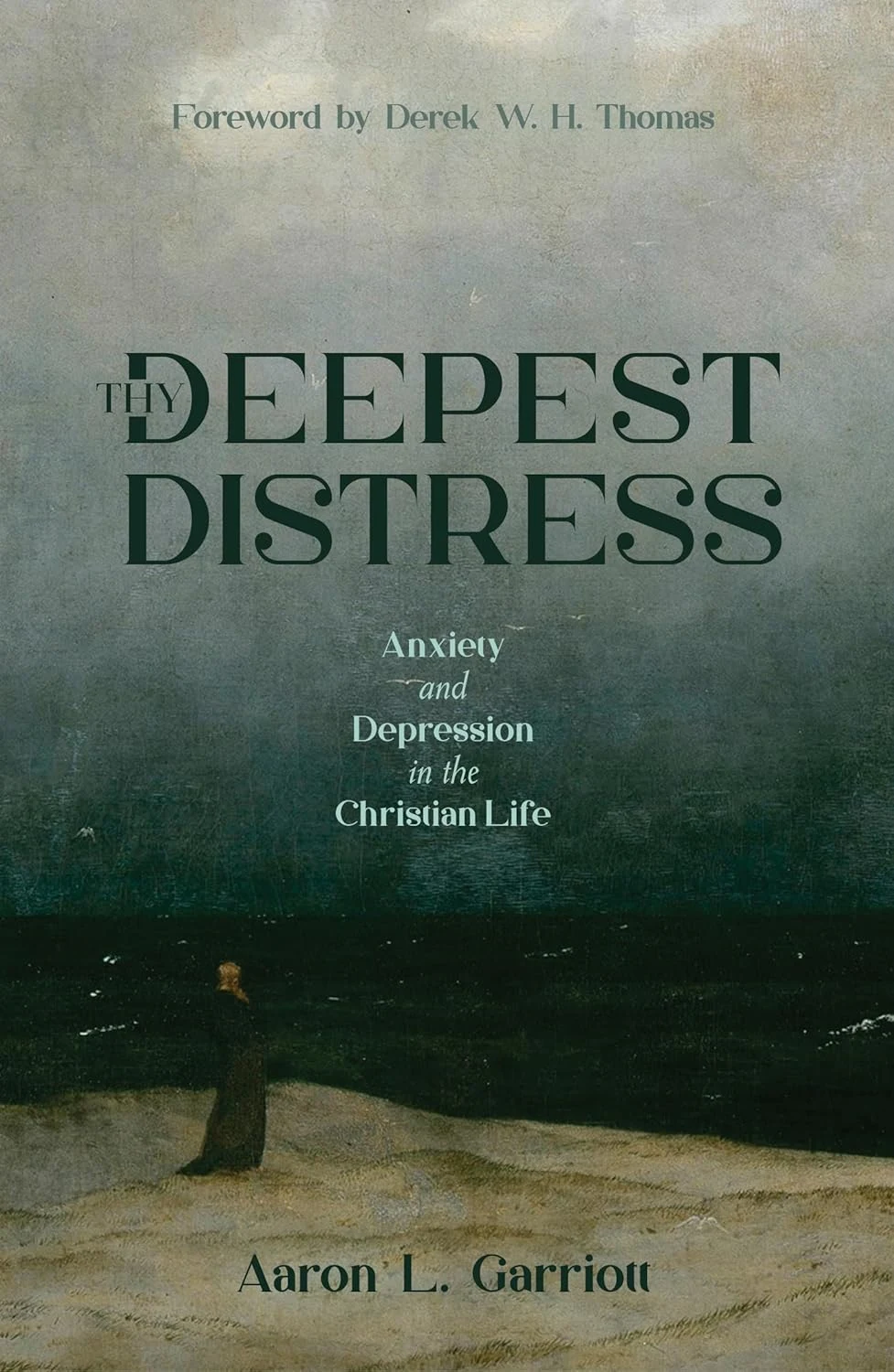
A Soul Beset: Anxiety and Depression in the Christian Life


Anxiety and depression mean different things to different people. Some people have experienced debilitating anxiety and despair that has found them in the back of an ambulance, in a psychiatric ward, or in a counseling center, while others have the occasional anxious or despairing thought that passes briefly through their minds before they fall into a peaceful sleep. For some, anxiety and depression can make it difficult to perform daily basic tasks. For others, they might come around only a few times every year and not significantly disrupt everyday life. This experiential range is demonstrated in the various ways in which people use the words. “I’m anxious” could mean no more than mild eagerness (e.g., “I’m anxious for the outcome of this basketball game”), or it could mean an unbearable distress. “That’s depressing” could be a reaction to an inconsequential alert (e.g., “It’s depressing that the Chicago Bulls lost”), or it could mean indescribable darkness.
Yet no matter where one finds himself or herself on the spectrum of this affliction, the reality remains: Anxiety and depression are not merely modern phenomena, nor are they outside the scope of God’s providential care. The Puritans spoke of the “dark night of the soul,” that period of despair when the assurance of God’s love feels as distant as the stars on a cloudy night. Nothing is more painful. Even the psalmist cries, “Why are you cast down, O my soul, and why are you in turmoil within me?” (Ps. 42:5). The experience of anxiety and sorrow is not foreign to the people of God, and yet Scripture does not leave us without comfort. Nor does it leave us without resources to press on in faithfulness.
For many Christians, the question of suffering—particularly suffering that arises from within—is among the most perplexing of theological challenges. Why, if I belong to Christ, does my soul still tremble? Why does peace, which He promised to leave with His people, seem so elusive? Where is the peace that surpasses all understanding that I was promised in Philippians 4:7? These are not questions that can be answered with mere sentimentality. They require a robust biblical understanding of both the nature of human frailty and the unwavering sovereignty of God.
The Christian life is not a life free from affliction, but it is a life in which affliction is never meaningless.
To that end, it is crucial to acknowledge that anxiety and depression, while certainly influenced by spiritual realities, are also deeply intertwined with the way we are physically made. We are not souls trapped in bodies; we are embodied souls. The great minds of the Christian tradition—John Calvin, Charles Spurgeon, and even the great theologian of joy, C. S. Lewis—understood that the human experience is one of profound complexity. The fall has wrought havoc not only on the will and affections but also on the mind and body. Thus, the experience of anxiety and depression is not necessarily a mark of weak faith but a mark of our shared human frailty.1
What, then, shall we say? If anxiety is an unwelcome guest, should we seek only to expel it, or is there something to be learned even in its presence? The gospel speaks to our fears and our sorrows, not by offering a quick fix or a mere change of perspective, but by grounding us in the eternal realities of God’s unshakable love, His providential care, His sovereign power, and His glorious promises. The God who calls us to “[cast] all [our] anxieties on him” (1 Peter 5:7) does not do so as a distant deity unconcerned with the details of our distress. He does so as the one who took on human flesh, who wept at the tomb of His friend, who sweated drops of blood in Gethsemane, and who bore our griefs on the cross.
My new book Thy Deepest Distress is not written to provide a simple, formulaic solution to the struggles of anxiety and depression. In fact, it’s not even written to provide a “solution” at all. Rather, it is written to remind weary hearts that they are not alone—that the God who holds the universe together is the same God who upholds His children, even when their minds feel fractured and their hearts weighed down. It’s written to offer a different perspective on what might seem to you to be your biggest setback in life.
If you find yourself in the midst of anxiety’s tightening grip or depression’s dark shadow, take heart: This is not an accident. The one who formed you in your mother’s womb is the same one who sustains you even now. The Christian life is not a life free from affliction, but it is a life in which affliction is never meaningless—nor is it by accident. In the hands of our gracious and sovereign God, even our sorrows become instruments of grace. And in the end, we hold fast to the promise that though “weeping may tarry for the night, . . . joy comes with the morning” (Ps. 30:5).
-
See Kelly Kapic, You’re Only Human: How Your Limits Reflect God’s Design and Why That’s Good News (Brazos Press, 2022). ↩