Leadership and Service in Christ’s Church

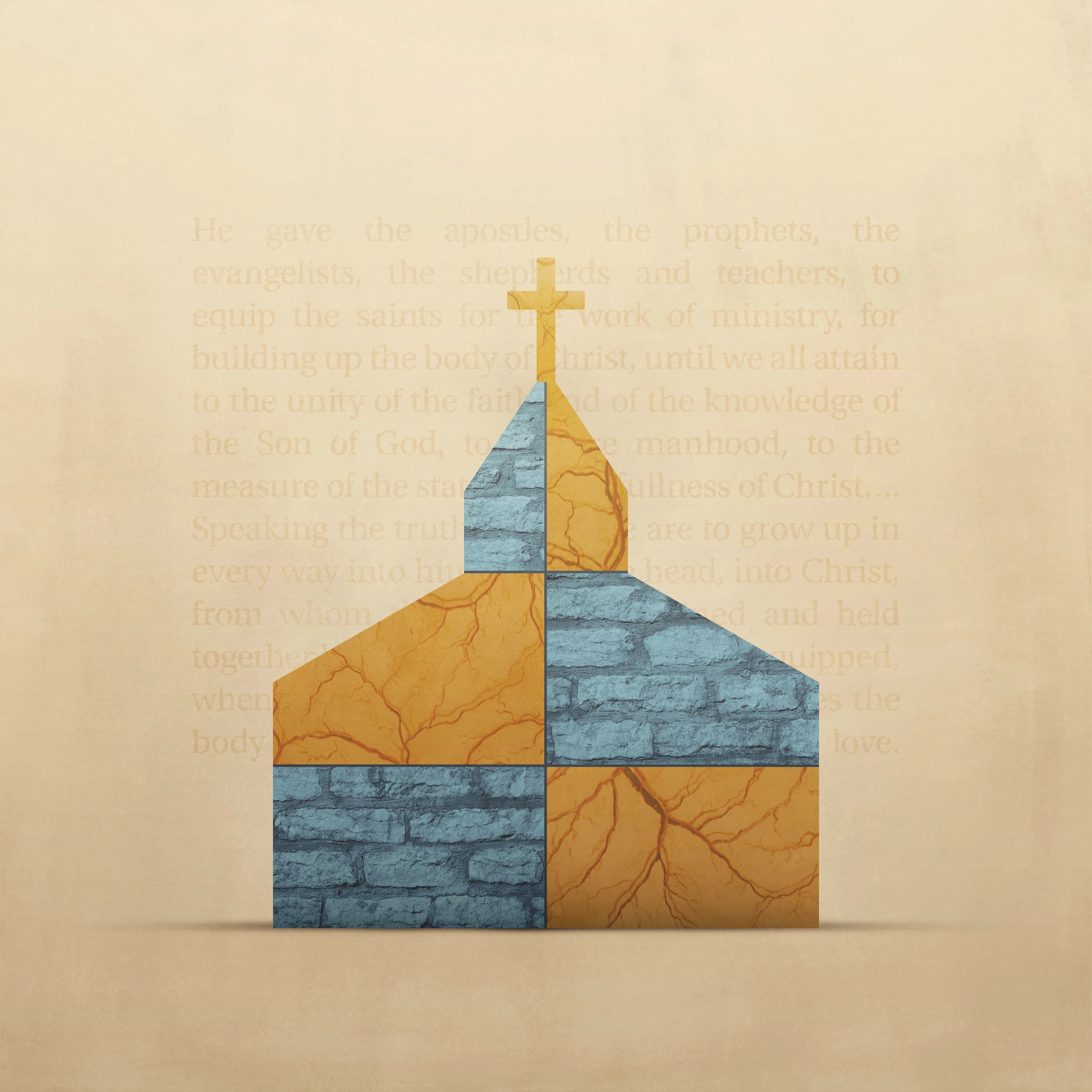
The Apostle Paul uses the imagery of a building and a body to illustrate the network of leadership and service in Christ’s church. The building is the new temple indwelt by God’s Spirit (Eph. 2:19–22)—not a static structure of stone and wood, but a dynamic community of people, made alive by their union with Christ, the life-giving stone (1 Peter 2:4–5). Consequently, alongside the picture of the church as building, Paul employs the body image to illustrate the church’s organic and interdependent life (1 Cor. 12:12–31). These images—body and building—together portray the interconnected framework of leadership and service that sustains the church’s life and mission in the world.
Today we are familiar with “body builders” who flex muscles and lift weights. Almost two millennia ago, Paul strikingly merged organic (body) and architectural (building) pictures, in order to reveal the link between leadership and ministry:
[Christ] gave the apostles, the prophets, the evangelists, the shepherds and teachers, to equip the saints for the work of ministry, for building up the body of Christ, until we all attain to the unity of the faith and of the knowledge of the Son of God, to mature manhood, to the measure of the stature of the fullness of Christ. . . . Speaking the truth in love, we are to grow up in every way into him who is the head, into Christ, from whom the whole body, joined and held together by every joint with which it is equipped, when each part is working properly, makes the body grow so that it builds itself up in love. (Eph. 4:11–16)
Paul starts by listing five (or maybe four) groups of leaders: Apostles, prophets, evangelists, pastors and teachers (or “pastors who are teachers”). These leaders communicate God’s Word to others. Apostles and prophets received special revelation by God’s Spirit and conveyed God’s very words to others, first in preaching and then in the written Scriptures. Because “the mystery of Christ . . . has now been revealed to his holy apostles and prophets” (Eph. 3:4–5), Apostles and prophets are the foundation of the church’s faith, for their writings testify to Christ Jesus, “the cornerstone” (Eph. 2:20). Subsequently, evangelists, pastors, and teachers now build on that foundation by explaining and applying the Bible’s timeless truths, both to unbelievers (evangelists) and to believers (pastors, teachers).
In other letters, Paul speaks of overseers (also called elders) and deacons (Phil. 1:1). Because these leadership positions involve responsibility for others and accountability to the Lord, they require noteworthy spiritual maturity. Men with good reputations as “full of the Spirit and of wisdom” were called by the church to oversee ministries of mercy (Acts 6:1–7). Likewise, Paul lists qualifications—focusing mainly on character—both for overseers/elders, who shepherd saints spiritually, and for deacons, who care for their material needs (1 Tim. 3:1–13; Titus 1:5–9; see also 1 Peter 5:1–4).
Some elders are gifted and called to “labor in preaching and teaching” (1 Tim. 5:17), so “teacher” fits their role well. But all elders must be “able to teach,” to speak the word of God (1 Tim. 3:2; Titus 1:9; Heb. 13:7), since it is by applying Scripture that they protect the flock and “care for the church of God” (Acts 20:28). Churches publicly acknowledge God’s call and gifting by ordaining these leaders, laying hands on them with prayer (Acts 6:6; 1 Tim. 4:14; 5:22).
Leaders motivate, recruit, train, and deploy all the members of the body, each with his or her own gifting from God’s Spirit, to engage in ministries of speaking, of discipling, and of mercy.
In Ephesians 4, as we have seen, Paul begins with the leaders whom Christ gives to His church. But then he introduces the ministries of all believers, of every member of the body: “the whole body, joined and held together by every joint . . . when each part is working properly, makes the body grow so that it builds itself up in love” (Eph. 4:16, emphasis added). In contrast to the medieval church, which generally viewed ordinary (lay) Christians as passive recipients of grace mediated through popes, bishops, and priests, the New Testament teaches that all believers belong to “a holy priesthood,” so we all offer spiritual sacrifices to God (1 Peter 2:5) and function as arteries to convey His grace to other members of the body.
How does this life-sustaining, growth-producing “circulatory system of grace” work? Leaders who teach the Word (today, pastors and elders) are “to equip the saints for the work of ministry.” Then, as the saints are equipped and serve each other, the result is “building up the body of Christ” (Eph. 4:12). God’s design is not for pastors, elders, and deacons to do all the work of the church while “ordinary” members sit passively in pews, absorbing but never exercising the capacities to care for others that God’s Spirit conferred when “grace was given to each one of us according to the measure of Christ’s gift” (Eph. 4:7, emphasis added).
This interdependent ministry of all church members, from those with high visibility to those often unnoticed, is the subject of Paul’s deepest exploration of the church as the body of Christ (1 Cor. 12). His key points are as follows:
- The one Holy Spirit draws all believers—despite our diverse backgrounds—into one body (1 Cor. 12:12–13).
- This one Spirit gives us a variety of gifts, so we can use those abilities “for the common good” (1 Cor. 12:4–7).
- Believers with low-visibility gifts must appreciate how indispensable they are to the health of the whole body (1 Cor. 12:14–19).
- Believers with high-visibility ministries need to know how much they need what often-overlooked fellow Christians can supply (1 Cor. 12:21–26).
Recognized (ordained) leaders—pastors, teachers, elders, deacons—set the pace in teaching the Word, discipling the immature, and extending mercy to those in need. And by setting the pace, leaders motivate, recruit, train, and deploy all the members of the body, each with his or her own gifting from God’s Spirit, to engage in ministries of speaking, of discipling, and of mercy (1 Peter 4:10–11). Here are two examples:
-
In Jerusalem, the Apostles ordained seven men to minister mercy, so that widows would not go hungry (Acts 6:1–7). Later in Joppa, a disciple named Tabitha was “full of good works,” clothing widows through her skills as a seamstress (Acts 9:36–39). Deacons organized and motivated by example, while others who had no special office displayed the reality of their faith by caring for “orphans and widows in their affliction” (James 1:27; see Acts 4:32–35; 1 John 3:16–18).
-
Writing to the Colossians, Paul described his distinctive calling as an Apostle, authorized to preach God’s Word: “[Christ] we proclaim, admonishing everyone and teaching everyone in all wisdom” (Col. 1:28, author’s translation, emphasis added). Later, using the same words, he directed all the Christians in Colossae: “Let the word of Christ dwell in you richly, in all wisdom teaching and admonishing one another” (Col. 3:16, author’s translation, emphasis added).1 Paul proclaimed Christ, admonishing and teaching others in all wisdom, so that they in turn could teach and admonish each other. The Apostle had equipped the saints for their work of service.
When both leaders and other members of the body together take to heart the countercultural example and instruction of Jesus, their Lord who came to serve (Mark 10:42–45), their synergy deepens the church’s beautiful unity and fuels its growth.
-
The ESV wording of Colossians 1:28 and 3:16 is modified slightly to reflect the Greek vocabulary and syntax. ↩