Who Was William Tyndale?

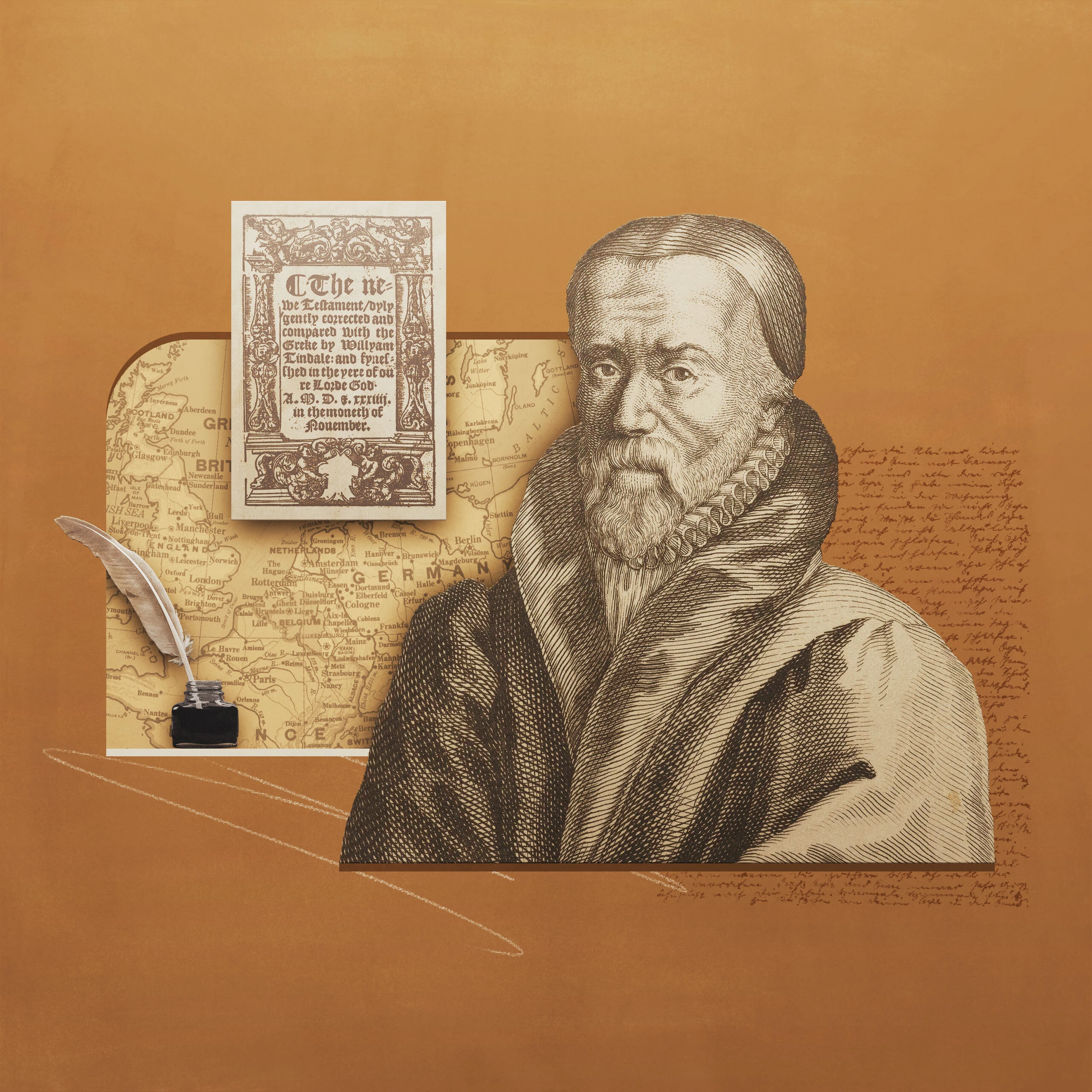
William Tyndale’s New Testament stands at the headwaters of the English Reformation and the reception of Protestant ideas into England. The year 2026 marks the five hundredth anniversary of William Tyndale’s (1494–1536) English translation of the New Testament first being smuggled into England and distributed to both commoners and nobles, clergy and laity alike.
Who was William Tyndale?
Tyndale was a humanist scholar trained at Oxford, where he earned a Bachelor of Arts and a Master of Arts. In 1515, he was ordained as a Roman Catholic priest in London. He agreed in the main with Erasmus of Rotterdam’s critique of church abuses and impieties. He also agreed specifically with Martin Luther’s theological insights on faith and justification, as well as Luther’s objections to papal authority. In the roaring twenties of the sixteenth century, Tyndale wanted to see the reformation of church and society in England from ploughman to priest according to the Word of God, resonating with early Lutheran Protestantism. Convinced that reformation starts by divine grace through faith with the spiritual transformation of the individual in reading, knowing, and believing the Scriptures, Tyndale set about his work.
Why was William Tyndale in exile from England?
In 1523, a year after Luther had published his German translation of the New Testament directly from Greek, Tyndale wanted to do the same thing for English-speaking lands that Luther had done for Germany, articulating similar reasoning. The episcopal authorities in London flatly forbade the project. By even suggesting the endeavor, Tyndale signaled to English authorities in the kingdom, church, and universities that he harbored Lutheran sympathies. The act of translating Scripture into English had been strictly regulated, if not totally forbidden, in England for over one hundred years. In 1400, the Archbishop of Canterbury and Henry IV promulgated a statute on the punishment and burning of heretics stemming from ecclesiastical condemnations of John Wycliffe (c. 1330–1384) and the Lollards for their stance on Scripture, field preaching, and private Bible study meetings (known as conventicles). In 1408, the Constitutions of Oxford, under the same Archbishop of Canterbury, Thomas Arundel, promulgated this specific prohibition with life-threatening force that was still in effect in Tyndale’s day:
Therefore, we have established and ordained that no one hereafter may translate any text of Holy Scripture on his own authority into the English language or any other by way of book, treatise, or tract, nor shall any book, tract, or treatise of this kind, already recently composed in the time of the said John Wycliffe (c. 1384), or since then composed, or hereafter to be composed, be read, whether in part or in whole, publicly or privately, under penalty of major excommunication until that translation shall have been approved [by bishop or perhaps by a regional council] . . . whoever acts contrary to this shall be punished similarly as a promoter of heresy and error.
This English canon law threatened death for heresy as well as the loss of all property for oneself and one’s heirs. Taken together, translating Scripture without ecclesiastical and royal permission was dangerous. On October 24, 1526, the Bishop of London, Cuthbert Tunstall, denounced English Lutherans, and commanded under pain of excommunication and suspicion of heresy all people to “bring in and really deliver” all books containing these translations. As a result of this denunciation, Tyndale’s Bible was publicly burned by the hangman of London.
After he was forbidden by his bishop to translate and publish his English New Testament, Tyndale went into exile in May 1524. He likely made for the Continent—perhaps Wittenberg, and certainly the printing centers of Germany and the Low Countries—where his books could be published abroad and sent back into England, legally or not. From outside of England, Tyndale was a vocal and timely commentator on Scripture and early Protestant concerns. For example, in The Practice of Prelates (1530), Tyndale argued from the Scriptures against the abuses of the Roman Catholic prelacy, as well as against Henry VIII’s divorce from Queen Catherine I of Aragon. Despite the best efforts of the English court of Henry VIII to extradite Tyndale back to England as a heretic for his Protestant beliefs, translation project, and Bible-smuggling endeavors, Tyndale never saw the inside of an English court.
In 1535, the imperial and ecclesiastical authorities in the Holy Roman Empire arrested Tyndale in Antwerp—a major printing center, travel port, and hive of Protestant expatriate activity. He was brought to trial in August of 1536, not for translating and publishing Scripture (which was tolerated somewhat more than in England), but for his expressed and published Protestant views. Tyndale was condemned as a heretic for believing and promulgating that faith alone justifies, that forgiveness of sins and embracing gospel mercy was sufficient for salvation, that human traditions—especially Roman Catholic Church tradition—cannot bind the conscience except where neglect might cause scandal, and that the Blessed Virgin Mary and the saints should not be invoked for intercession in prayer or public worship. After being defrocked of his priesthood, he was executed.
May the Lord grant us grace to be found daily and often in His Word.
In Tyndale’s A Pathway into the Holy Scripture, a summary of how to read the Scriptures, he remarked upon the condemnation and suppression of vernacular translations and the persecution of Bible translators in his day:
I do marvel greatly, dearly beloved in Christ, that ever any man should repugn or speak against the Scripture to be had in every language, and that of every man. For I thought that no man had been so blind to ask why light should be shown to them that walk in darkness, where they cannot but stumble, and where to stumble, is the danger of eternal damnation; other so despiteful that he would envy any man . . . so necessary a thing; or so bedlam mad to affirm that good is the natural cause of evil, and darkness to proceed out of light, that lying should be grounded in truth and verity, and not rather clean contrary, that light destroys darkness, and verity reproves all manner of lying.
What was the impact of Tyndale’s translation of the New Testament?
It is estimated that over eighteen thousand copies of Tyndale’s New Testament were printed and distributed. The impact of this translation upon English Christians in that period of time and upon every translation of the English Bible since are profound and far ranging. It was Tyndale who gave us the distinctive phrasing of John 3:16, “For God so loved the world,” which is now commonplace. Also, many English theological terms trace back to Tyndale. For example, the use of the term “atonement” (literally “at-one-ment”) in Romans 5:11 marks a development instead of the Latin word reconciliatio. It is also a Tyndalian emphasis in 2 Corinthians 5:18 to say, “preaching of the atonement” (compare to the King James Version, “ministry of reconciliation”). Next, there is in Tyndale’s 1534 translation his usage of the term “elder” throughout 1 Timothy. It was distinctive in the era for replacing the word “priest.” While the 1526 first edition of the New Testament lacked marginal notes and glosses, the 1534 second edition was replete with them. Understandably, these were more ardently and fiery Protestant after the 1526 edition was burned. Over the past five hundred years, Tyndale’s work of translating the Bible into vernacular English has had a lasting impact on every English translation of Scripture.
The lasting witness of Tyndale the man, however, is perhaps more profound and weighty, representing a generation of Reformation-era Christians willing to sacrifice everything for the promulgation of the Bible. More than ten years later, while in exile from England, Tyndale reflected on his experience in The Obedience of a Christian Man (Antwerp, 1535) and exhorted his readers:
Let it not make thee despair, never let discourage thee, O Reader, that it is forbidden thee in pain of life and goods or that it is made breaking of the King’s peace or treason unto his highness to read the Word of thy soul’s health. But much rather be bold in the Lord and comfort thy soule. For as much as thou art sure and hast an evident token through such persecution that it is the true Word of God; which Word is ever hated of the World, nor was it ever without persecution (as thou seest in all the stories of the Bible both of the New Testament also of the Old) nor can be no more than the sun can be without its light.
May the Lord grant us grace to be found daily and often in His Word, and like Tyndale, may we labor and support its promulgation and reception in faith.