What Language Was the Bible Written In?

William Tyndale (1490s–1536) was an English scholar and linguist who is best known for his courageous and tireless efforts to translate the Word of God into the vernacular, so that both prince and pauper could read and understand the gospel for themselves. He was not the first to undertake this task. John Wycliffe (c. 1330–1384), who preceded Tyndale by about 140 years, had already worked to translate the Bible into English. Wycliffe based his translation on the Latin Vulgate. Tyndale sought to walk a similar path to Wycliffe’s, but he based his English translation of the Bible not on the Vulgate but on the languages in which it was originally written. Tyndale’s focus on the original languages underlined his interest in returning to the primary sources to provide the people with greater clarity regarding both the substance of their faith and the soundness of their piety.
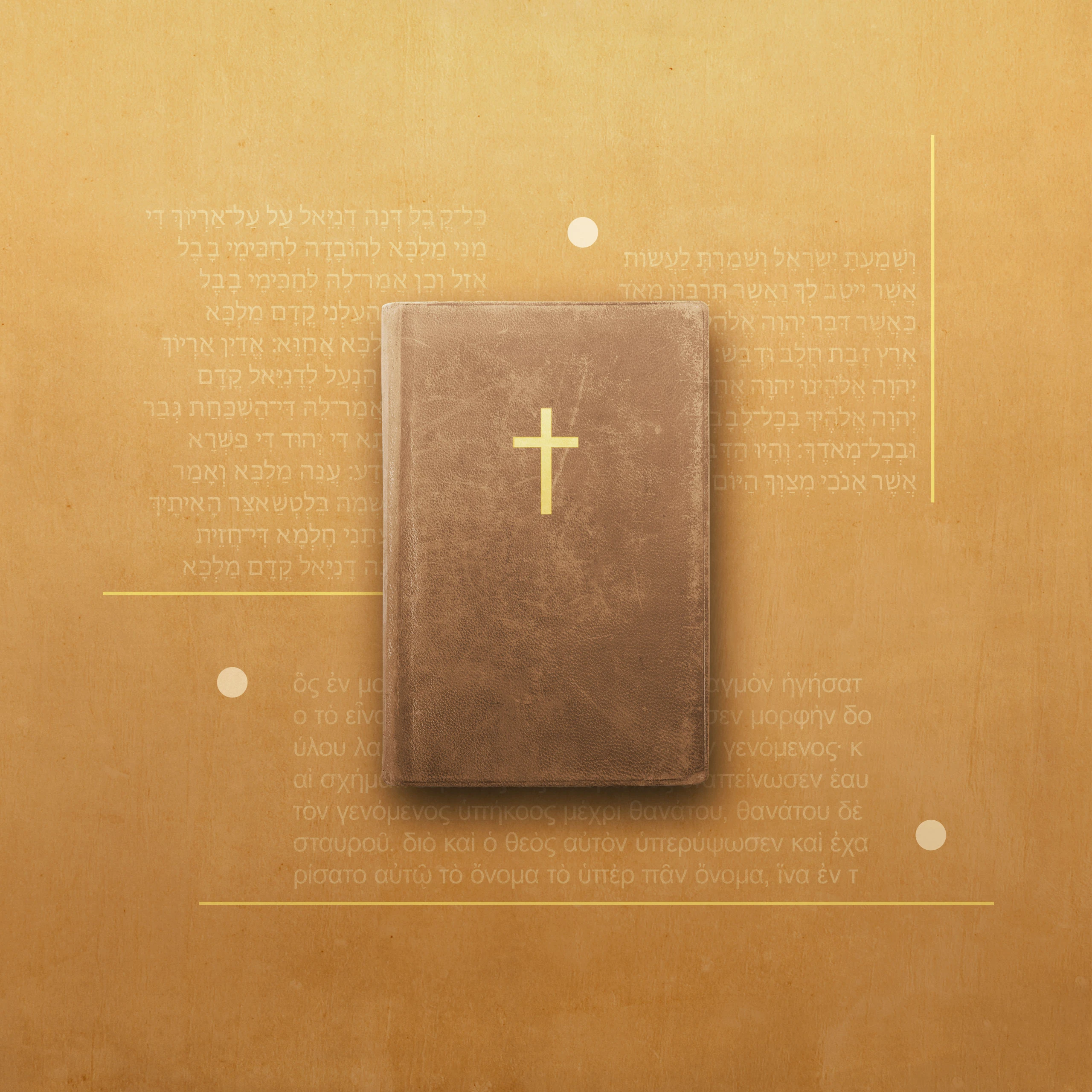
The Bible was originally written in three distinct languages: Hebrew, Aramaic, and Greek. The Old Testament was composed primarily in Hebrew and Aramaic, both of which belong to the Northwest Semitic branch of the larger Semitic language family. The term Semitic is derived from the name of Noah’s son Shem, while Northwest Semitic refers to a group of languages that developed in the region now covering modern-day Lebanon, Israel, Palestine, Syria, and Jordan. This language group includes other ancient languages such as Ugaritic, Phoenician, and Moabite, as well as others.
The great majority of the Old Testament was written in Hebrew. Though smaller in scope, but no less important, the Aramaic portions of the Old Testament appear in Daniel 2:4–7:28 and then in Ezra 4:8–6:18 and 7:12–26. Although Hebrew and Aramaic remained distinct languages, the growing influence of Aramaic during and after the exile to Babylon led Hebrew scribes to adopt the Aramaic square script, which is the form that characterizes the Hebrew text to this day.
When we read the Bible today with the help of the Holy Spirit, whether in a careful English translation or with the original languages open before us, we are still hearing that same clear and living voice.
While Hebrew continued to be used among the Jewish people, Aramaic had become a common feature of daily life in Palestine among Jews into the New Testament period. Jesus Himself spoke Aramaic, and a number of Aramaic words and phrases are preserved in the Gospels, such as talitha cumi (“Little girl, I say to you, arise,” Mark 5:41), Abba (“Father,” Mark 14:36), and Eloi, Eloi, lema sabachthani (“My God, my God, why have you forsaken me?” Mark 15:34).
The New Testament was written in the Greek language. This particular form of Greek is known as Koine Greek, which means “common.” This simplified yet flexible Greek came into widespread use in the wake of Alexander the Great’s military conquests. Alexander led his armies eastward against the Persian Empire and, by 326 BC, had forged an empire stretching from Macedonia and Greece to Egypt in the south and into the borders of India. His campaigns proved instrumental in spreading both Greek culture and language across the known world of his day. Just as Aramaic had earlier become the common tongue of the Ancient Near East, Greek now became the shared language of the Mediterranean world, often serving as a second language for many conquered peoples.
The linguistic dominance and widespread usage of Koine Greek did not fade when Rome later conquered Greece and established its own supremacy. By the first century, Greek remained the language of commerce, administration, and intellectual life throughout the Roman Empire’s eastern provinces. It was the language of documents, letters, and ordinary conversation on the street. It was also the language of the Gospels, the Acts of the Apostles, the Epistles, and the book of Revelation. The New Testament writers’ use of the common language of the people was one means by which the message of the Christian faith expanded beyond the confines of its original Jewish context to reach the broader gentile world. This was a language perfectly suited to be understood not only by specialists or a rarified priestly class, but by everyone from the prince to the pauper.
The story of these three languages—Hebrew, Aramaic, and Greek—reminds us that the God of Scripture has always been willing to speak in the ordinary tongues of His people. He did not wait for a sacred or specialized dialect. He addressed shepherds, exiles, fishermen, and tentmakers in the living languages of their day. Tyndale’s labor to return to those primary sources was driven by the simple conviction that the Word of God belongs to the whole church and not merely the province of a learned few. When we read the Bible today with the help of the Holy Spirit, whether in a careful English translation or with the original languages open before us, we are still hearing that same clear and living voice, a voice that continues to make the substance of the faith and the path of true piety plain to all who have eyes to see and ears to hear.