Who Is Gabriel?

When we think of the angel Gabriel, we probably think of his appearances to Zechariah and Mary in the opening chapter of Luke’s gospel, especially around the Christmas season. Yet Gabriel’s story begins long before the New Testament. In the Old Testament, angels are members of God’s heavenly court (Job 1:6; Ps. 103:20); they praise Him continually (Ps. 148:2); they provide for and protect God’s people on His behalf (Ex. 23:20); and, perhaps most commonly, they bring important messages from God to His people. The angel Gabriel is one of only two holy angels mentioned by name in Scripture (the other is Michael), and he first appears not in Luke’s gospel but in the book of Daniel to foretell the coming of the Messiah and God’s kingdom. We should remember Gabriel not primarily because he appeared to Zechariah and Mary, but rather because he first appeared to Daniel and afterward to Zechariah and Mary.
In the Old Testament, Gabriel appears in one of Daniel’s prophetic visions to explain to him what is going to happen. Israel during the time of Daniel was in the midst of exile. The Babylonian empire had conquered the final portion of Judah and had hauled the remaining Israelites to exile in Babylon. Jerusalem lay in ruins, and no king was on the throne, while Daniel served the royal court at the pleasure of the Babylonian and later the Persian kings. After observing the startling vision of a one-horned goat defeating a two-horned ram, Daniel sees Gabriel (whose name means “mighty man of God”) standing before him, and Gabriel proceeds to explain to Daniel that the ram and goat signify “the time of the end” when the Greeks will defeat the Medes and Persians (Dan. 8:19–22). After the vision, Daniel prays for the restoration of God’s people, and Gabriel shows up again to tell him what comes next. Gabriel announces that Jerusalem will be rebuilt, the Anointed One, the Messiah, will come, and God’s kingdom will be established forever (Dan. 9:24–27).
Because of his prominence in Daniel’s prophetic ministry, Gabriel played an important role in non-biblical Jewish literature during the period between the Old and New Testaments. For example, in 1 Enoch (written 300–200 BC), Gabriel appears notably as part of God’s heavenly council alongside the angels Michael, Raphael, and Uriel. Gabriel and the others are responsible for observing human matters and reporting them to God (1 Enoch 9, 20, 40), and he is even tasked with executing God’s judgment on wickedness (1 Enoch 10). While 1 Enoch is not canonical Scripture, it does reveal that Jews during the time of Jesus held Gabriel in high esteem, viewing him as one of God’s most important messengers. They understood that when Gabriel shows up, an earth-shattering message is about to be announced.
Gabriel’s appearances in Daniel and Luke form a bridge between promise and fulfillment, and this reminds us that the God who speaks is the God who acts.
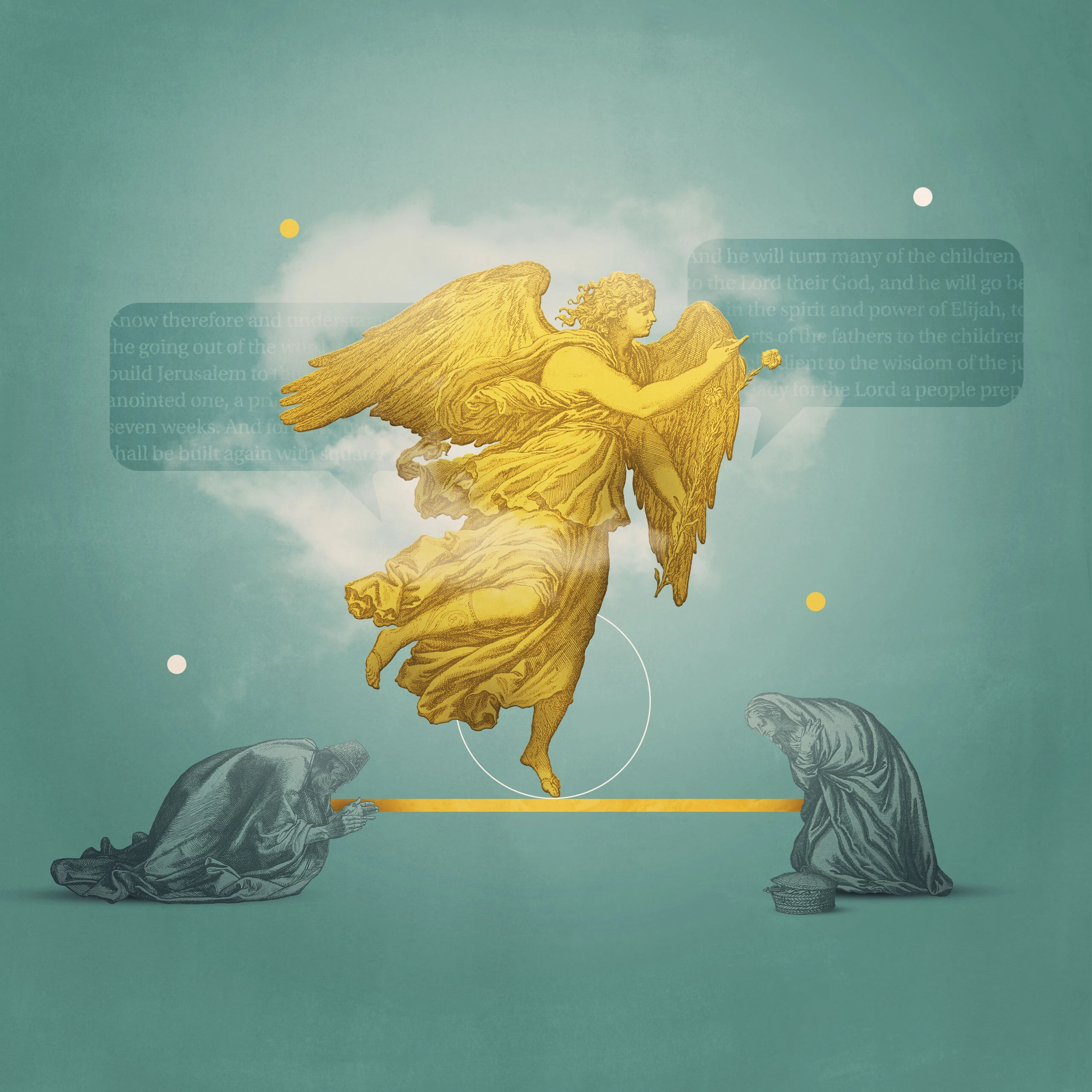
In the New Testament, Gabriel announces the message of all messages in the first chapter of Luke’s gospel. Luke opens his orderly account by describing Gabriel’s visit to the priest Zechariah, who was offering incense in the holy place of the temple in Jerusalem. At first, Gabriel merely announces the message without identifying himself. He tells Zechariah that his wife, Elizabeth, will bear a son named John who will prepare the way for the Lord (Luke 1:8–17). Zechariah should have known who the angel was from the message alone, but when he responds in unbelief, Gabriel identifies himself by name. As a trained priest, Zechariah would have immediately known that this was the same Gabriel who appeared to Daniel and that that ancient message was about to unfold. But because of the fogginess of his faith, Gabriel declares that Zechariah will be unable to speak until these things come to pass.
In contrast to Zechariah, when Gabriel appears to the virgin Mary, she believes his message even without Gabriel identifying himself. Gabriel arrives in Nazareth and explains that Mary will conceive and give birth to a son whose name will be Jesus, which means “the Lord saves.” This son, Gabriel explains, will be the Son of the Most High, He will sit on the throne of David, and His kingdom will have no end (Luke 1:26–33). Significantly, this account strongly echoes Gabriel’s encounter with Daniel, where Gabriel announces the same message: the coming of the Messiah and the establishment of God’s everlasting kingdom (Dan. 8:16–17; 9:21–27). In this way, the angelic messenger who formerly announced to Daniel the coming Anointed One now stands before Mary to declare that He is about to arrive. When Mary asks how this is possible since she has never been with any man, Gabriel tells her that the child will be conceived by the Holy Spirit (Luke 1:34–35). Unlike Zechariah, Mary did not need Gabriel to identify himself, for she knew the truth of the ancient prophecy when she heard it. The result for her was not a curse of silence, but rather a joyful song in which she praises her God for His faithfulness to David, a song known as her Magnificat (Luke 1:46–55).
When we meet Gabriel in Scripture, we find more than a random messenger who just happens to have a name. Gabriel’s appearances in Daniel and Luke form a bridge between promise and fulfillment, and this reminds us that the God who speaks is the God who acts. May we all find great comfort in our promise-keeping God.