Who Was Aaron?

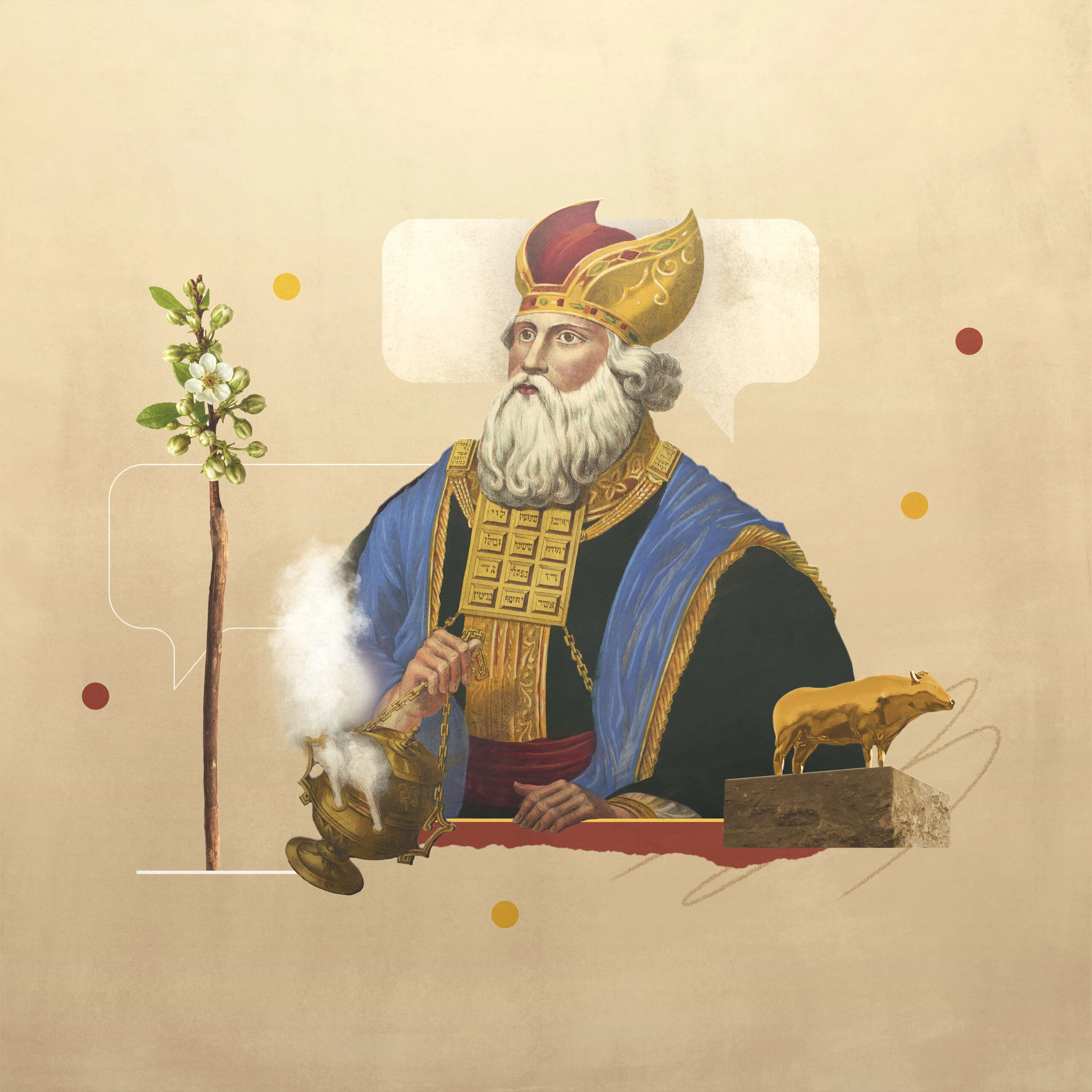
What must it have been like to be Aaron? He was the father of priests, the mouthpiece of a prophet, but also the consummate “number two man” of the Bible.
Throughout the Old Testament Scriptures, the portrait painted of Aaron reveals a multifaceted and sometimes contradictory profile that we would expect from an actual historical person. As they say in literary studies, Aaron is a round character, with personality, remarkable successes, and surprising failures—not a flat character, as we would expect if his life were merely an ancient myth.
Growing up in the Israelite slave community of Egypt, Aaron could not have imagined that the people of God would one day walk victoriously out of the nation of their captivity, much less that he himself would play a major role in that deliverance, even commanding an audience in Pharaoh’s court. Such an experience must have created a multitude of conflicts within him. He had grown up as a slave, but now he was confronting kings.
Aaron’s first calling came directly from the Lord (Ex. 4:27). He was to meet his brother, who had returned from exile, and serve in a remedial role, accommodating his brother’s speech impediment by speaking on his behalf (Ex. 4:10–16). It is in this sense that Aaron’s first calling was as a mouthpiece for Moses, just as Moses was a mouthpiece of God (Ex. 4:16). Moses spoke the word of God, but Aaron spoke the word of Moses.
As such, his role was a secondary one, and he is often mentioned alongside Moses in the descriptions of the latter’s interaction with the Egyptians. It must be assumed that it was Aaron’s voice, not Moses’, that rang out in the Egyptian throne room during those heated negotiations with Pharaoh.
His role as a religious leader of Israel, in which he facilitated the worship of the Lord, began to form during the events of the exodus. He seems to be the one whom the people were more willing to approach with their needs. It is quite possible that Aaron would have been better known to the people, as Moses was somewhat estranged from them due to his upbringing in the Egyptian household. This perfectly suited Aaron as an intercessor between the people and Moses, and ultimately God. However, it also created the occasion for Aaron to be led astray by the whims of the crowd.
In the case of the golden calf, the people approached Aaron while Moses was meeting with the Lord on the mountain and petitioned him to make an idol for worship (Ex. 32). When confronted by Moses, Aaron denied his culpability in the incident (Ex. 32:22–24). Later in the wandering, Aaron was swayed again by the people when he joined his sister, Miriam, in claiming authority from God while casting suspicion on Moses for marrying a non-Israelite (Num. 12:1–2). Furthermore, Aaron’s struggles with unbelief seem to have been passed on to his sons, who turned against the Lord and lost their lives as a result (Lev. 10:1–2).
His story begs for a sequel, for a greater high priest who will live up to His calling and truly atone for sin and intercede for the people. In this way, Aaron is the shadow of Jesus Christ, our better High Priest.
Aaron’s secondary call was to be a priest, a calling that would demand of him the utmost holiness. As the high priest, he would be subject to the rules that constrained the high priests’ lifestyle, ensuring he maintained the highest level of religious purity, which allowed him to enter the Holy of Holies on behalf of the people (Lev. 21:10–15). Aaron would be limited as to where he could go, the foods that he could eat, and the people he could interact with, even more than the regular priests of the tabernacle.
The priests of Aaron also had the difficult task of monitoring the cleanliness of the priests, the Levites, and the people, while also warning against the hypocritical use of the religious practices of the tabernacle and the temple. It is a common complaint from prophets elsewhere in Scripture that the Israelites were constantly tempted to use the tabernacle and its sacrificial system as a sort of superstitious talisman that relieved them from the responsibility to honor the moral law of the covenant (1 Sam. 15:22–23; Jer. 7; Hos. 6:6). This put Aaron and his descendants in the unpopular position of having to shepherd a people who often did not want to be shepherded, while also acting as a type of religious police who had to monitor the behavior of their countrymen.
On several occasions, the Lord spoke directly to Aaron (Ex. 4:27; Lev. 10:8; Num. 18:1). Aaron and his descendants, the priests, also had custodial duties over the Urim and Thummim, a set of stones that were authorized by God as a method by which the king might inquire of the Lord (Lev. 8:5–9). It would have been significant to Aaron and every priest in his lineage that the king himself would have to come to them in order to inquire of the Lord.
Despite his failings, Aaron’s calling was holy and central to the life of the people of God. His descendants, the priests, and the whole tribe of Levi were uniquely set apart to serve the people. The priests were ordained in a ceremony that set them apart from the rest of their tribe and nation (Lev. 8:1–13). Not only the priest, but the whole tribe of Levi was similarly ordained for the special responsibility of serving in the sanctuary (Num. 3:5–10; 8:10–11; see also Num. 4:27). This special place of Aaron and the Levites among the tribes of Israel is perhaps most vividly displayed in the fact that his staff was placed with the staffs of the rest of the tribes within the Tent of Meeting, but Aaron’s staff alone miraculously blossomed with flowers and produced ripe almonds (Num. 17:1–3).
The person of Aaron surely presents a conundrum that is common in the Old Testament. A flawed character is put forth for a task for which he is terribly unqualified. Although gifted with divine revelation and miraculous signs, he repeatedly falls short of his high calling. As a result, his story begs for a sequel, for a greater high priest who will live up to His calling and truly atone for sin and intercede for the people. In this way, Aaron is the shadow of Jesus Christ, our better High Priest (Heb. 4:14–5:10).