Who Was Cyril of Alexandria?

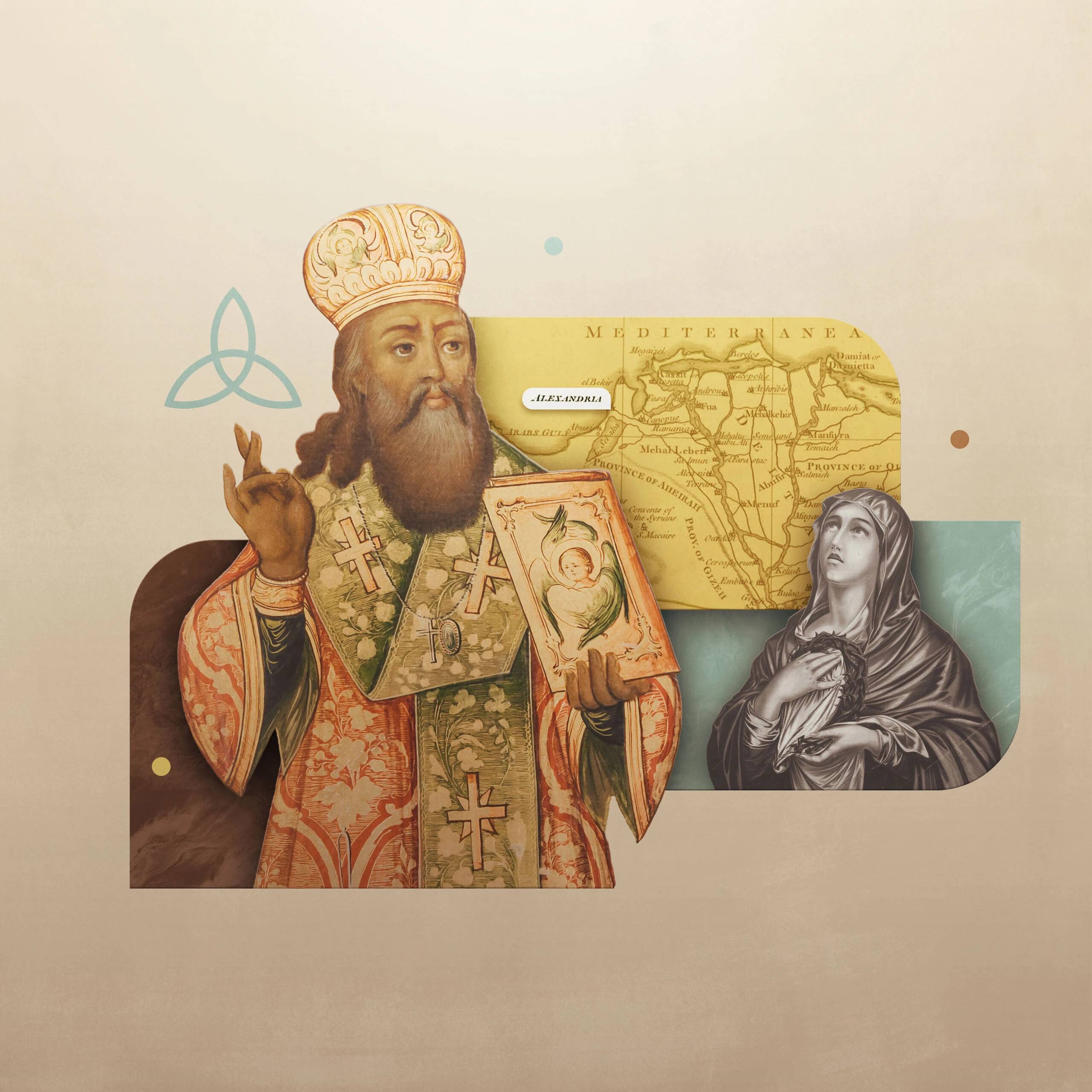
Cyril of Alexandria (c. AD 376–444) isn’t often listed alongside greats like Athanasius and Augustine, but he probably deserves to be. His preaching and writing profoundly shaped the way the church thought about the person of Christ, and especially the glorious salvation He brings to His people.
Early Years
In 412, Cyril became archbishop of Alexandria. The city was known for frequent rioting and unrest, and Cyril’s early years as archbishop were marked by conflict. He weighed in on tension between Christian groups as well as tension with the Jewish population, and he had a longstanding feud with the city’s governor. Infamously, a pagan philosopher named Hypatia was brutally murdered by a mob at this time, and some ancient writers attempted to lay the blame at Cyril’s door. He has been easy to villainize as a result, and a rather inaccurate portrait of him as a power-hungry bully became very popular among modern liberal scholars. The truth is that Cyril spent the majority of these years doing the ordinary work of a bishop: preaching, leading worship, and writing biblical commentaries. His emerging reputation as an intelligent scholar of Scripture was about to be road tested.
Stepping into Controversy
In 428, a popular Syrian preacher named Nestorius became archbishop of Constantinople, taking the most influential pulpit in the world. Almost immediately, Nestorius sparked controversy because of the way he would speak about the person of Christ. Nestorius began preaching against a title traditionally given to Mary: theotokos (“God-bearer” or “Mother of God”). The title was designed to capture the extraordinary reality of the incarnation: A young woman had given birth to God the Son in human flesh (John 1:14). But Nestorius felt this was the wrong view of Christ. The baby born of Mary—naked, crying, and dependent on her for feeding and washing—could not be the eternal, unchanging God. Mary, he reasoned, was the mother only of the man Christ, not the Son of God. In other words, there had to be a clear dividing line between the man born of Mary and the divine Son of God. He spoke of Jesus as though He were a man uniquely joined to, or partnered with, the eternal Son rather than God the Son Himself come in human flesh. He preferred to speak of Mary as Christotokos (“Christ-bearer”).
Cyril started with Jesus Christ and allowed Him to unveil the Father and His heart.
Nearly seven hundred miles south in Egypt, Cyril was alerted to all this. He had spent years studying the Trinity and writing biblical commentaries, and he knew he had to engage. Cyril saw clearly what Nestorianism meant. If the One born of Mary and who later hung on the cross was not God Himself, then God had not come down to save us. Nestorius’ “Jesus” was a human man being raised up—a supercharged moral example, the ideal patron saint of those who intend to win salvation for themselves.
Getting Christ Right
Cyril was called to chair the Council of Ephesus in 431, where church leaders gathered and agreed to oppose Nestorius and his teaching. There was only one Lord Jesus Christ, and He could not be split in two, for our salvation had to be wrought by God Himself. A human empowered by divine assistance was no Savior. This meant that the person in action throughout Jesus’ earthly life—whether walking on water or falling asleep in a boat, whether healing the sick or suffering crucifixion—was none other than God the Son in the flesh. This was the identity of the baby born of Mary. The Council of Chalcedon in 451, seven years after Cyril’s death, crystalized all this further. God the Son had an eternal divine nature, and, to this, He added a true and full human nature in the incarnation. These two natures remain distinct in Jesus, but they are not separate persons or different sons, as was the consequence of Nestorius’ teaching. There was only one person working for our salvation in all the blood, sweat, and tears—the Son of God, the Lord Jesus Christ.
God with Us
Cyril’s great contribution was not so much about getting the terminology right. He believed that the Jesus we imagine deeply shapes our view of God and the salvation He offers. Like Paul, Cyril saw that a distorted Jesus goes hand in hand with a distorted gospel (2 Cor. 11:4). Whereas Nestorius had a preconceived view of God and struggled to fit Jesus into it, Cyril started with Jesus Christ and allowed Him to unveil the Father and His heart. The God revealed in Jesus was pleased to draw near to sinful humanity in person (Col. 1:19–20)—not at arm’s length, nor through a proxy, but personally. God the Son came to us, clothed in our humanity, laid down His life, and took hold of us when we could not save ourselves. In Jesus, God truly loves sinners, up close and personal. The One who holds the world together is the same One who wept at the tomb of Lazarus, who grew tired after a journey, and who shed His blood on the cross for our redemption. He is Immanuel, God with us.
We have Cyril of Alexandria to thank for steering the church to worship and wonder at so great a salvation.