Who Was Esther?

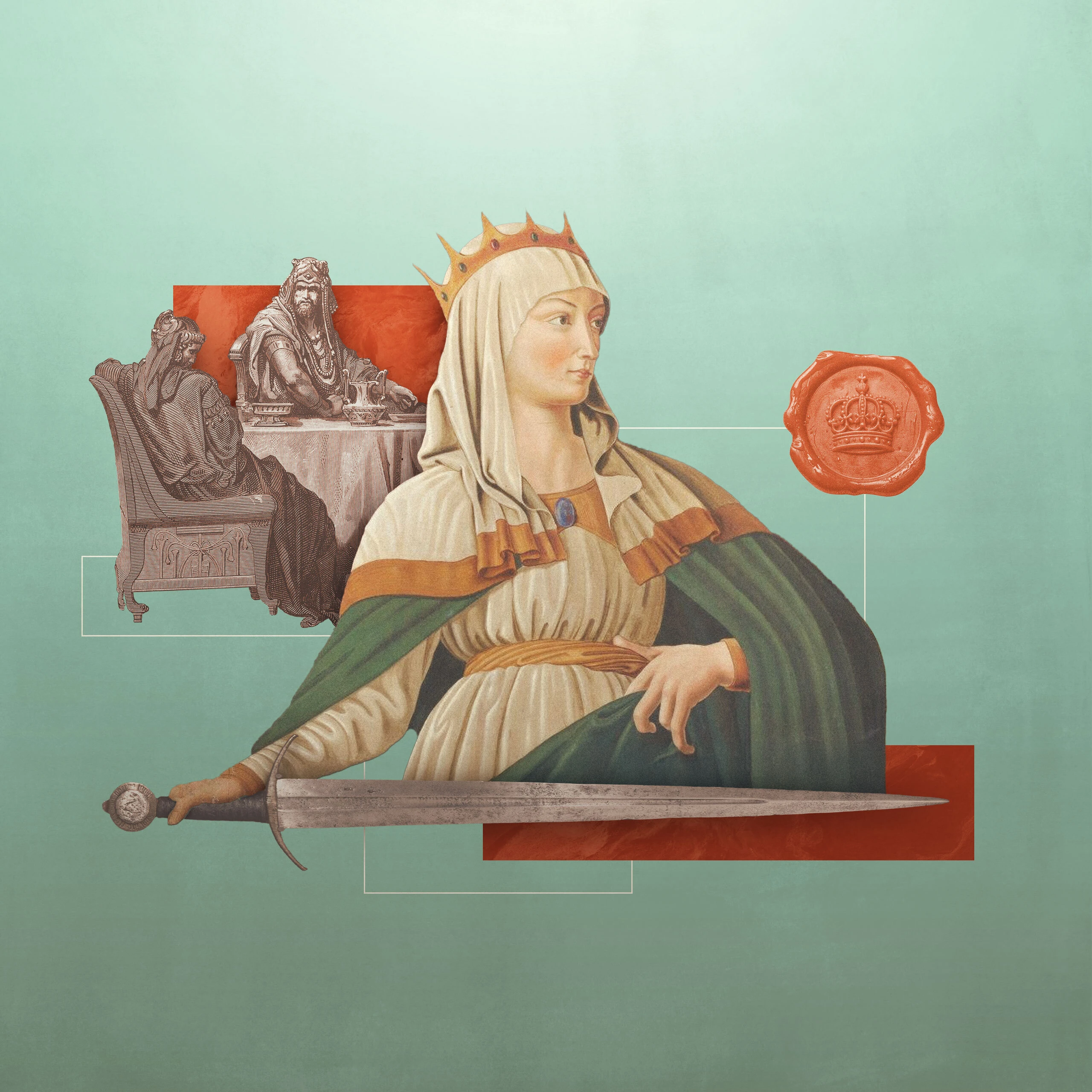
Hadassah was a young woman who lived in the ancient, bustling city of Susa—located in modern-day southwestern Iran—around 480 BC. Her mother and father had died, so her older cousin, Mordecai, took her in and raised her. Susa was an important city, serving as a capital of the Persian Empire after the Persians defeated the Babylonians in 539 BC, bringing the Neo-Babylonian Empire to an end. Shortly after this conquest, Cyrus issued his decree allowing the Jews to return to Israel and rebuild the temple (see Isa. 44:28; Ezra 1–2). While many Jews returned to do just that, others remained in the lands where they had settled during the exile. Mordecai and his adopted daughter were among them. She went by her Persian name, Esther. In God’s providence, this young woman would play a vital role in preserving God’s ancient people and in securing the fulfillment of His ancient promises.
Esther is said to have been a beautiful woman (Est. 2:7). At that moment in the Persian kingdom, beauty was a dangerous thing, for it was precisely what the Persian king was seeking. King Ahasuerus’ wife, Vashti, had humiliated him before his guests at his own feast. In response, the king decided to replace her. He ordered the most beautiful women in the empire to be gathered to his chambers for what was essentially a degrading “tryout.” Each woman would spend one night with the king in order for him to choose the next queen. Esther was swept up into this lewd beauty pageant. During the year-long period of preparation, Esther concealed her Hebrew identity at Mordecai’s urging.
When the time came for Esther to enter the king’s chambers, she continued her pattern of winning favor with those in the palace: “The king loved Esther more than all the women, and she won grace and favor in his sight more than all the virgins” (Est. 2:17). Within a year, Esther had gone from an orphan girl to queen of the most powerful empire in the world. But this was hardly the end of her story.
Shortly after Esther was crowned, Mordecai discovered an assassination plot against the king. The crisis was averted and the deed recorded in the king’s annals. Mordecai had saved the king’s life. Yet instead of reward or recognition, there was nothing. No honor. No celebration. Just ink on a page. Until one sleepless night.
Before that sleepless night, however, Mordecai had a fateful run-in with the king’s chief official, Haman. Haman was an Amalekite, which means he should not even have existed, but Saul’s disobedience had allowed that wicked line to continue (see 1 Sam. 15). Enraged, Haman manipulated the king into issuing a decree ordering a day of slaughter: the annihilation of all Jews—“young and old, women and children” (Est. 3:13)—throughout the empire.
Esther, the secretly Jewish queen of Persia, was now in a dreadful position. Mordecai pressed her to use her influence to stop the massacre. But there was a problem. Though Esther was indeed the king’s wife, she could not simply walk into his presence whenever she pleased. She told Mordecai:
All the king’s servants and the people of the king’s provinces know that if any man or woman goes to the king inside the inner court without being called, there is but one law—to be put to death, except the one to whom the king holds out the golden scepter so that he may live. But as for me, I have not been called to come in to the king these thirty days. (Est. 4:11)
What happened next provided an opportunity for Esther’s courage and shrewdness to shine. When the king saw her standing there in her royal robes, he welcomed her and offered her up to half his kingdom. But Esther was patient. She did not reveal her intentions immediately. Instead, she asked permission to prepare a feast for the king and Haman. At that feast, the king renewed his offer: “What is your wish? It shall be granted you. And what is your request? Even to the half of my kingdom, it shall be fulfilled” (Est. 5:6). Again, Esther waited:
My wish and my request is: If I have found favor in the sight of the king, and if it please the king to grant my wish and fulfill my request, let the king and Haman come to the feast that I will prepare for them, and tomorrow I will do as the king has said. (Est. 5:7–8)
Haman, the enemy of the Jews, returned home elated and drunk, boasting in his riches and honor. Yet his hatred for Mordecai would not let him rest, so he had thirty-five-foot gallows prepared from which Mordecai would be hanged the next morning.
In God’s providence, Esther would play a vital role in preserving God’s ancient people and in securing the fulfillment of His ancient promises.
Unfortunately for Haman, that was the very night the king could not sleep. The king’s remedy for insomnia was to have the book of memorable deeds read to him. There he was reminded of Mordecai’s loyal discovery of the assassination plot. The king remembered the deed, but not any reward for it. No king worth his salt would allow a loyal deed to go unrewarded. So, he summoned Haman and instructed him to parade Mordecai (his worst enemy) through the city in public honor. One can almost hear Haman’s misery:
So Haman took the robes and the horse, and he dressed Mordecai and led him through the square of the city, proclaiming before him, “Thus shall it be done to the man whom the king delights to honor.” (Est. 6:11)
Before Haman had time to recover from the humiliation, it was time for Esther’s second banquet. When the king again asked Esther to state her request, she finally spoke plainly:
If I have found favor in your sight, O king, and if it please the king, let my life be granted me for my wish, and my people for my request. For we have been sold, I and my people, to be destroyed, to be killed, and to be annihilated. (Est. 7:3–4)
The king was stunned. Who would dare do such a thing? Esther answered with force: “A foe and enemy! This wicked Haman!” (Est. 7: 6). Haman was then hanged on the very gallows he had prepared for Mordecai. What sweet justice!
But one problem remained: Though Haman was dead, his decree still stood. And such an edict could not simply be revoked. Esther therefore appealed again to the king:
If it please the king, and if I have found favor in his sight, and if the thing seems right before the king, and I am pleasing in his eyes, let an order be written to revoke the letters devised by Haman . . . which he wrote to destroy the Jews. (Est. 8:5)
The king granted her request in the only way Persian law allowed:
You may write as you please with regard to the Jews, in the name of the king, and seal it with the king’s ring, for an edict written in the name of the king and sealed with the king’s ring cannot be revoked. (Est. 8:8)
The resulting counter-decree, sent out with the same authority and urgency as the first, granted the Jews the right of overt self-defense: “The Jews were to be ready on that day to take vengeance on their enemies” (Est. 8:13). And when the day came, “the Jews struck all their enemies with the sword, killing and destroying them” (Est. 9:5). The Lord had preserved His people. Through this orphan-turned-queen, He proved Himself to be their “shield, and the horn of [their] salvation, [their] stronghold” (Ps. 18:2). To commemorate this deliverance, Esther established the feast of Purim.
Although Mordecai’s words to Esther may have carried undue pressure, they nevertheless proved true: “And who knows whether you have not come to the kingdom for such a time as this?” (Est. 4:14). Though Esther’s story is fraught with moral compromise and strange turns, the Lord’s invisible hand governs every movement. She reminds us that the same is true for us as well, irrespective of whether we perceive it:
God moves in a mysterious way
His wonders to perform;
He plants His footsteps in the sea,
And rides upon the storm.
Deep in unfathomable mines
Of never-failing skill
He treasures up His bright designs
And works His sovereign will.
Ye fearful saints, fresh courage take;
The clouds ye so much dread
Are big with mercy and shall break
In blessings on your head.
Judge not the Lord by feeble sense,
But trust Him for His grace;
Behind a frowning providence
He hides a smiling face.
His purposes will ripen fast,
Unfolding every hour;
The bud may have a bitter taste,
But sweet will be the flow’r.
Blind unbelief is sure to err,
And scan His work in vain;
God is His own interpreter,
And He will make it plain.1
God’s purposes ripened fast with Esther, unfolding every verse. Through what seemed like a painful chain of events, the young woman who had been forced into marriage with a divorced pagan king became a mighty instrument in the hands of God. If Hadassah/Esther was anything, she was that: a providential weapon, raised up by God for the preservation of His people and the destruction of His enemies.
-
William Cowper, “God Moves in a Mysterious Way.” ↩