Who Was Jonathan Edwards?

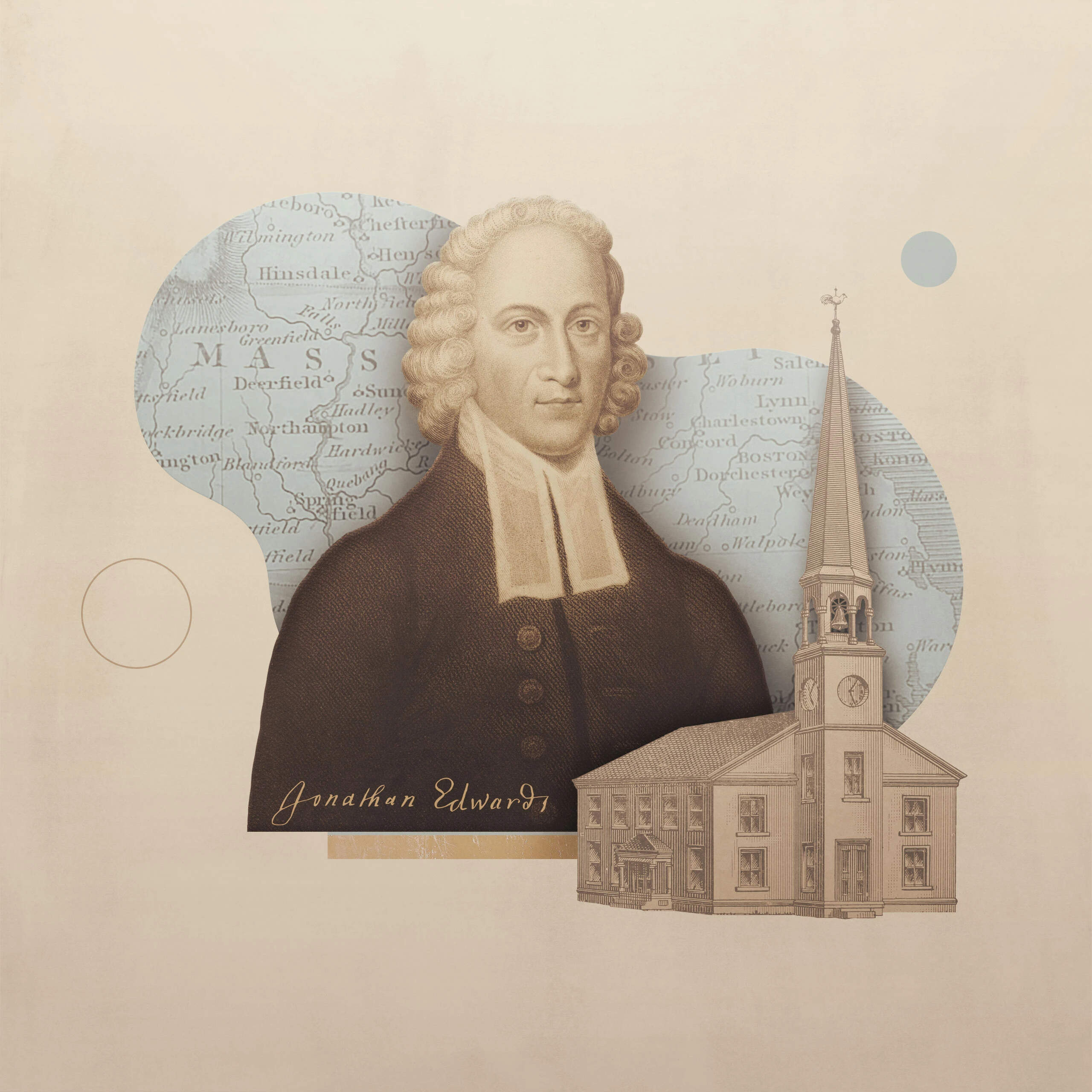
Jonathan Edwards was one of the great theologians of American history. A Congregational pastor in New England during the colonial era, his published writings attracted much attention during his lifetime and have continued in popularity to the present day. Ongoing interest in Edwards’ works is attributable to his keen theological insights, intense personal piety, and the controversies of his lifetime, all of which still have relevance for Christian faith and practice today.
Jonathan Edwards is considered one of the last New England Puritans. A Calvinist by conviction, his theological writings affirmed the general outlines of historic Reformed theology. He was a prominent leader in the evangelical revivals of the 1730s and 1740s that would become known as the Great Awakening.
Born in East Windsor, Connecticut, in 1703 to Timothy and Esther Edwards, Jonathan was an only son with ten sisters. Timothy was a Congregational pastor, as was Esther’s father, Solomon Stoddard, a well-known minister in Northampton, Massachusetts.
Jonathan was a bright student, entering Yale at the age of twelve and graduating in 1720. He remained at Yale two more years to study theology, receiving a license to preach in 1722. Edwards pastored a Presbyterian church in New York for eight months and returned to Yale as a tutor for two years. In 1724 he was called as an assistant to his grandfather, Solomon Stoddard, at the Northampton church. In 1727 he married Sarah Pierrepont, whose father was also a pastor. Together they raised eleven children. When Stoddard died in 1729, Jonathan Edwards became the congregation’s pastor.
In 1734–35, the Northampton congregation was stirred to revival through the preaching of their new pastor, who wrote about these events in A Faithful Narrative of the Surprising Work of God in the Conversion of Many Souls in Northampton (1737). During one six-month period, three hundred members were added to the church. In 1741 at Enfield, Connecticut, Edwards preached what would become his most famous sermon, “Sinners in the Hands of an Angry God.” In this sermon, he graphically described hell’s terrors with Christ as the only escape. Though he is known for this famous sermon, it was not typical of Edwards’ preaching style.
As a Calvinist, Edwards put great emphasis on God’s sovereign salvation of sinners in his sermons and treatises.
Church authorities condemned the emotional excesses popularly associated with the revivals. Edwards defended the awakening in his sermon “The Distinguishing Marks of a Work of the Spirit of God,” given at the 1741 Yale graduation. In the sermon, he argued that despite incidents of heightened affections, the
extraordinary influence that has lately appeared on the minds of people abroad in this land, causing in them an uncommon concern and engagedness of mind about the things of religion, is undoubtedly, in the general, from the Spirit of God.
Responding to critiques of preaching about hell, Edwards stated, “If I am in danger of hell, I should be glad to know as much as I possibly can of the dreadfulness of it.”
As a Calvinist, Edwards put great emphasis on God’s sovereign salvation of sinners in his sermons and treatises. He revised some of the traditional ways Calvinists had expressed the faith. Two of Edwards’ theological treatises illustrate his insights in explaining Reformed doctrine: The Great Christian Doctrine of Original Sin Defended (1758) and Freedom of the Will (1754). In Original Sin Defended, Edwards argued that universal depravity of the human heart comes from Adam’s sin, due to a “constituted oneness” of Adam with the entire human race. Out of this “constituted union of the branches and the root” came universal human moral depravity, and man is guilty as a consequence of union with Adam. In Freedom of the Will, Edwards distinguished between “natural ability” and “moral ability,” asserting that post-fall humanity retained all natural faculties (ability) to do God’s will but no longer had the moral ability because of innate moral depravity. Edwards’ unique exposition of these doctrines became the foundation of “New England Theology” identified with later Edwardsean theologians who advanced beyond their teacher into more extreme views. His son, Jonathan Edwards Jr., was among these theologians.
Edwards’ Personal Narrative described a deepening experience with Christ in his twenties and a delight in divine things. In 1746 he wrote his first major work, A Treatise Concerning Religious Affections, explaining the nature of genuine religious experience. The necessity of conversion was a root cause of a divisive controversy in his congregation. His grandfather, Stoddard, had allowed outwardly virtuous persons in the town to partake of the Lord’s Supper, viewing communion as a potential “converting ordinance.” Edwards ceased this practice, requiring a personal profession of faith prior to membership, baptism, and participation in communion. This change became so disruptive that Edwards was dismissed from his pastorate at Northampton in 1750. He continued to preach for the congregation until they found his replacement.
Eventually, Edwards moved his family to Stockbridge, Massachusetts, where he pastored a congregation with ten English families and two hundred Mohican Native Americans. Edwards was an advocate for missions, encouraging “concerts of prayer” where God’s people gathered for prayer.1 He authored an influential American missionary biography, An Account of the Life of the Late Reverend David Brainerd. David Brainerd’s (1718–1746) short, difficult, but productive ministry among the Delaware Native Americans inspired numerous missionaries in the following generations. In his final year of life Jonathan Edwards became the third president of the new Presbyterian College of New Jersey (now Princeton) in 1758. He died within three months of accepting the post from a smallpox inoculation.
-
See his treatise: *An humble attempt to promote explicit agreement and visible union of God's people in extraordinary prayer for the revival of religion and the advancement of Christ's Kingdom on earth *(1747). ↩