Who Was Martin Bucer?

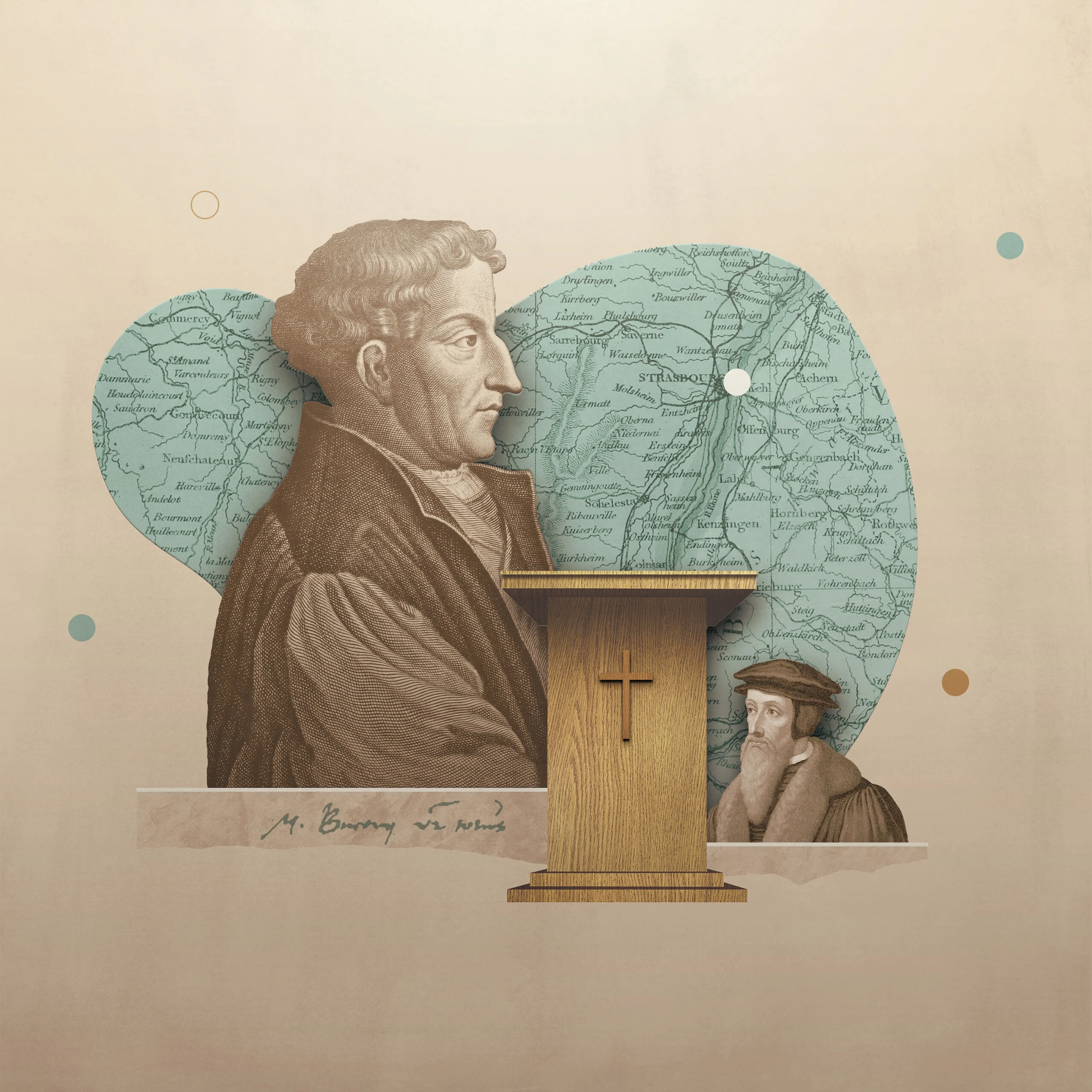
In 2015, while traveling to Germany for the Frankfurt Book Fair, I took the opportunity to visit Strasbourg to trace the steps of a nearly forgotten giant of the Reformation. I first stopped on Rue Martin Bucer, where Saint Aurelia’s Church still stands—the first congregation that Martin Bucer pastored in that city. Then, walking through the cobblestone streets of this historic place where Johannes Gutenberg first imagined his printing press and where a statue still honors his legacy, I made my way to the imposing Church of St. Thomas.
Inside the austere sixteenth-century architecture—a striking blend of ninth-century Romanesque, thirteenth-century Gothic, and Baroque elements—two things stand out. One is the grand eighteenth-century organ once played by Wolfgang Amadeus Mozart. The other, more modest yet more enduring, is a bust honoring Martin Bucer, the Reformer of Alsace. I was transported to the turbulent sixteenth century, to the time when Bucer became the pastoral heart of the Reformation. He was mentor to John Calvin and Thomas Cranmer, peacemaker among fractured Reformers, and above all, a shepherd of souls.
Standing there, one realizes that the Reformation was not sustained by theologians alone but by pastors. Few embodied that pastoral heart more clearly than Martin Bucer. But who was this man? And why should we remember him?
The Reformer You’ve Never Heard Of
“In memory of Martin Bucer, professor of holy Theology.” This simple metal plaque in St. Mary’s Church, Cambridge, placed there by Queen Elizabeth I in 1560, marks the final resting place of perhaps the Reformation’s most influential forgotten figure.
Martin Bucer exercised profound influence on John Calvin. He corresponded with Martin Luther, collaborated with Philip Melanchthon, debated with Huldrych Zwingli, and worked alongside Thomas Cranmer to shape the Book of Common Prayer. He produced at least ninety-six treatises, a complete Psalms commentary, and groundbreaking works on public theology (De Regno Christi) and pastoral ministry.
Yet today, his name barely registers.
Why? Perhaps because Bucer was never interested in building his own legacy. He spent his life taking on the challenge of uniting the different parties of the incipient Protestant movement.
From Monk to Reformer
Born in 1491 in Sélestat, France, Martin Bucer seemed destined for an ordinary life. The son of wine barrel producers, he entered the Dominican order at fifteen under pressure from his grandfather. By 1516, he was an ordained priest and expert in Thomistic scholasticism.
Then came 1518.
As a theology student in Heidelberg, Bucer heard an Augustinian monk named Martin Luther speak on the “theology of the cross,” one year after the fixing of the Ninety-Five Theses on the door of Castle Church in Wittenberg.
Luther’s discourse shattered Bucer’s scholastic certainties. He devoured Luther’s writings. Within three years, he obtained release from his monastic vows, and in 1522, he married a former nun and joined the Reformed cause.
But Wittenberg wasn’t in his future. On his way to study with Luther, Bucer stopped in Wissembourg and began preaching, and his Reformed preaching challenged the monastic system. The result? Excommunication and flight.
In 1523, he arrived in Strasbourg as a refugee. There he would serve for twenty-five years.
Forged as a Pastor in Strasbourg
Strasbourg welcomed him. On August 24, 1523, Bucer became pastor of Saint Aurelia’s Church, the very church I visited centuries later. In 1531, he moved to St. Thomas, where he would serve until the 1540s.
But Bucer’s vision extended far beyond his congregation. He dreamed of a united Reformed movement—Swiss, French, German, and English believers united under one confession of faith.
To pursue this seemingly impossible dream, he (1) attended the Colloquy of Marburg (1529), attempting to reconcile Luther and Zwingli on the Lord’s Supper, (2) helped draft the Confessio Tetrapolitana (1530) as an alternative to the Augsburg Confession for southern German Reformed cities, and (3) played a key role in the First Helvetic Confession (1536) to harmonize Swiss and German teaching.
In 1537, Bucer did something almost unheard of for sixteenth-century theologians: He published Retractationes, publicly acknowledging and correcting errors in his earlier positions on the Lord’s Supper. This humility unsettled some but revealed his character. Truth mattered more than reputation.
Luther encouraged him to press on.
Mentoring Calvin
In 1538, a dejected young Reformer named John Calvin was exiled from Geneva and arrived in Strasbourg. Bucer took him in.
For three years—which Calvin later called the happiest of his life—the young Frenchman lived under Bucer’s mentorship. In Strasbourg, Calvin wrote his Romans commentary, revised his Institutes, met his wife Idelette, and pastored French refugees.
Bucer understood something we often forget: Caring for souls requires doctrinal zeal, personal presence, and community structure working together.
Calvin’s assessment of his mentor?
Martin Bucer is a man who, on account of his profound erudition, his abundant knowledge of a wide range of subjects, his keen mind, his vast reading, and many other varied virtues, remains today unsurpassed by anyone, can be compared to only a few, and stands out from the great majority.
The towering John Calvin saw himself as Bucer’s student. What Calvin admired most was not merely Bucer’s intellect, but his pastoral wisdom.
But what made Bucer so exceptional wasn’t just his theological acumen; it was his pastoral heart.
The Heart of a Shepherd: Five Tasks of Soul Care
Of Bucer’s many writings, his work On True Soul Care (Von der wahren Seelsorge, 1538) best reveals what drove him. In it, he outlined five essential tasks for those who shepherd God’s people:
- Evangelization: Lead to Christ and communion with Him those who do not yet know Him—whether trapped in the sins of the flesh or bound by false worship.
- Restoration: Recover those who were brought to Christ and His church but were led astray by the flesh or false doctrine.
- Discipline: Assist and guide to true reform those who, though still in Christ’s church, have fallen gravely into sin.
- Edification: Restore to true Christian strength and health those who have persevered in communion with Christ but have become spiritually weak and frail.
- Encouragement: Protect from all offense and continually encourage in all good things those who remain faithful in Christ’s flock.
This wasn’t mere theory. Bucer lived these principles in Strasbourg: He pressed civil councils to implement moral discipline, he created accessible catechetical schools, he organized godly elders to actively oversee the congregation’s spiritual life, and he argued that the church should be a living communion of regenerate believers who edify one another. The Ziegenhain Ordinance (1539), which he drafted, became a model of Reformed church discipline across Europe.
For Bucer, the communion of saints wasn’t an abstract doctrine. It was Christ’s kingdom made visible through the faithful care of souls.
Exile, Again
In 1541, Bucer’s wife died. He remarried the following year. But in 1549, the land that had sheltered him for twenty-five years turned against him. Political shifts forced him to surrender his positions and leave Strasbourg. At fifty-eight, Martin Bucer became a refugee again.
He went to England, where he served as professor of theology at Cambridge and assisted Thomas Cranmer with the Book of Common Prayer. His Censura contained some sixty proposals for Anglican liturgy, over twenty of which were adopted in the 1552 edition, particularly regarding the Lord’s Supper and church discipline.
On February 28, 1551, Martin Bucer died in Cambridge at age fifty-nine, far from his homeland. Queen Elizabeth I honored him with a memorial plaque. But his true memorial wasn’t bronze or stone—it was the souls he shepherded, the ministers he mentored (especially Calvin), and the theological foundations he laid for Reformed pastoral ministry.
Why Bucer Matters Today
Standing before his bust in Strasbourg, I realized I wasn’t just visiting a monument to history. I was encountering a challenge: Will we recover the true care of souls?
Bucer’s five tasks of soul care remain searingly relevant:
- Are we evangelizing those who don’t know Christ, or merely maintaining religious institutions?
- Are we restoring the wayward with patience and truth, or writing them off?
- Are we practicing discipline that reforms and heals, or turning a blind eye to sin?
- Are we building up the weak and weary, or assuming spiritual strength is their problem?
- Are we encouraging the faithful to press on, or taking their perseverance for granted?
Bucer understood something we often forget: Caring for souls requires doctrinal zeal, personal presence, and community structure working together. Truth without love crushes. Love without truth coddles. Community without doctrine drifts.
Thinking about our own times, in an age still marked by division, superficiality, and fragmentation, Bucer’s legacy remains urgent: a church rooted in truth; united in confession; structured for discipline; devoted to the patient, comprehensive care of Christ’s flock.
That is the true care of souls.