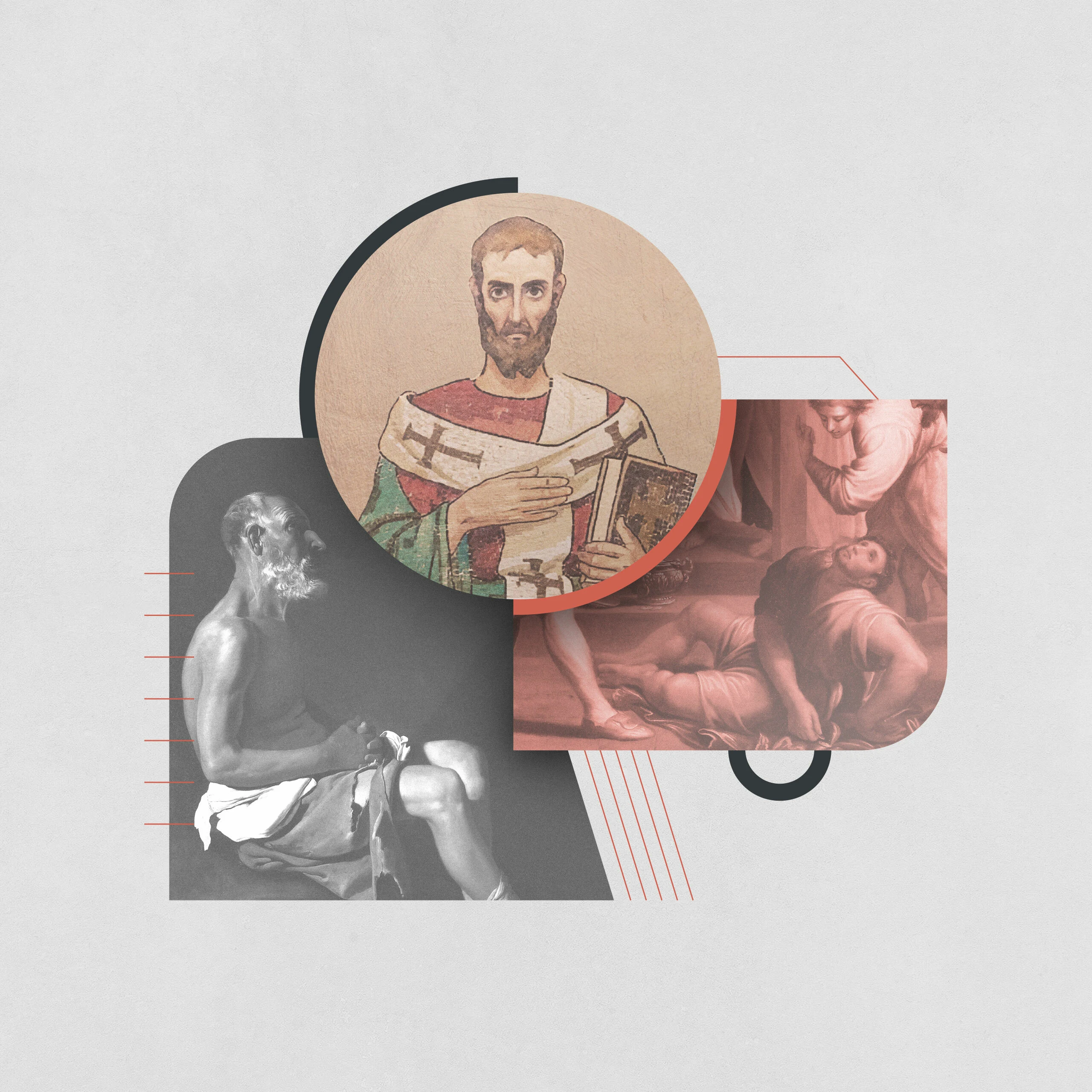
Who Was Paul?


Paul’s life was a testimony to the gospel that he preached, so knowing something about his life helps us have a fuller and richer grasp of his message. In this article we will look at what may be said about Paul’s life before his conversion. In my book, The Life and Theology of Paul, I give special attention to Paul’s call and conversion.
We have no biography of Paul, whether from his own hand or from someone else’s. Paul’s thirteen letters and Luke’s account of the early church (Acts), however, give us a window into Paul’s pre-Christian life. The details in Acts and Paul’s letters provide the necessary context for coming to a fuller appreciation of the ministry and message of the Apostle, since many of these details have relevance for our understanding of Paul’s Christian life and Apostolic ministry. Here are a few things we know about Paul.
1. Paul was marked by “weakness.”
The New Testament does not provide a physical description of Paul. It does, however, include an indirect comment from his opponents: “For they say, ‘His letters are weighty and strong, but his bodily presence is weak, and his speech of no account’” (2 Cor. 10:10). Based on this caricature, Paul does not seem to have been a physically imposing person, and his rhetorical abilities were not well regarded by his opponents. An early but apocryphal second-century description of Paul describes the Apostle as “a man of little stature, thin-haired upon the head, crooked in the legs, of good state in the body, with eyebrows joining and nose somewhat hooked, full of grace.”1
We do know that Paul undertook his Apostolic ministry in physical infirmity. He appears to have suffered some illness or debilitation when he preached in Galatia (Gal. 4:13). His listing of sufferings for Christ in 2 Corinthians 11:23–29 includes lashings, beatings, and being stoned. His body would surely have borne the marks of this brutal treatment (see Gal. 6:17). No assessment of Paul’s ministry, then, may attribute its success to the Apostle’s outward appearance. But Paul did not regard this factor as disqualifying him from his Apostolic ministry. On the contrary, he said such “weakness” was a mark of his ministry (see 2 Cor. 10:1–12:21).
2. Paul was also called Saul.
Attentive readers of the New Testament observe that early in the narrative of Acts, Luke consistently references the Apostle as “Saul.” Beginning in Acts 13:9, Luke consistently references him as “Paul.”2 Why the change in name?
The change is not because “Saul” was Paul’s pre-Christian name and “Paul” was his Christian name, as is commonly thought. For a significant portion of Paul’s early Christian life, Luke refers to the Apostle as “Saul.” Luke gives us a clue concerning the shift, rather, in Acts 13:9 (“But Saul, who was also called Paul”). Paul had both a Jewish name (Saul), and a Roman name (Paul). Paul’s Jewish name reflects his descent from the tribe of Benjamin (Phil. 3:5), whose most famous son was King Saul. The name “Paul” was one of three names that he would have received under Roman naming conventions; the other two are lost to history. “Paul” was his cognomen, or personal name.3 The occasion when Paul began to use his Roman name with consistency was a crucial one. It marked the beginnings of the Apostle’s labors among largely gentile populations. In the providence of God, Paul was a man whose names facilitated his ease of movement in both Jewish and gentile circles.
3. Paul was a Jew from the tribe of Benjamin.
In Philippians 3:5, Paul remarks that he was “circumcised on the eighth day, of the people of Israel, of the tribe of Benjamin, a Hebrew of Hebrews.” That Paul was circumcised on the eighth day according to the Mosaic law (see Gen. 17:12) tells us at least that his father was an observant Jew. That he was likely named for King Saul suggests his father’s embrace of his own heritage as an Israelite of the tribe of Benjamin. That Paul describes himself as “a Hebrew of Hebrews” tells us that Paul himself embraced his Jewish upbringing and did so with enthusiasm. For all the cultural pressures either to apostasy or to syncretism, Paul consciously remained an observant Jew.
We have already seen indications that Paul’s father was observant of the Mosaic law. We may presume that the family was faithful to worship regularly at their local synagogue and to travel regularly to Jerusalem in order to worship at the annual feasts that the Mosaic law required old covenant believers to attend. However, we do not have many specific details about Paul’s family members. We do know that Paul’s father was a Roman citizen, since Paul was born a Roman citizen and did not acquire his citizenship later in life. We do not know, however, under what circumstances or when Paul’s father came by that citizenship. In Acts 23:16 we learn that Paul had a nephew (“the son of Paul’s sister”) who presumably resided in Jerusalem. Paul, then, had at least one sibling and appears to have been on cordial terms with her.
4. Paul was single during his ministry.
Nowhere in his correspondence does Paul mention a wife or children of his own. At the time that he wrote 1 Corinthians, he was single, and that by God’s calling (1 Cor. 7:6–7).4 It is possible that Paul was a widower, but his marital history remains a matter of speculation.
5. Paul was a Roman citizen.
He appeals to his citizenship twice in the course of his Apostolic ministry (Acts 16:37; 22:28). In both cases, Paul invoked his citizenship because Roman officials were depriving him of rights that were his by Roman law. On another occasion, Paul invoked his right as a citizen to have his legal case transferred from the governor, Agrippa, to Emperor Nero (Acts 25:11). This transfer, Luke suggests, likely saved Paul’s life (Acts 25:3). In each instance, Paul used his citizenship to prolong his Apostolic preaching ministry and to extend its sphere.
Paul tells us that he was born in “Tarsus in Cilicia” (Acts 22:3). Tarsus was located not far from the Mediterranean coast in what is today southeastern Turkey. It was connected to other major cities by road, and it was an international center of learning. It was no backwater village; it was, in Paul’s words, “no obscure city” (Acts 21:39). Like other major Mediterranean cities, Tarsus housed a Jewish community. First-century Jewish communities, while distinct, were not isolated from the other peoples and cultures among whom they lived. As we shall see, Paul himself gives indications of having been raised in a cosmopolitan environment.
6. Paul was a Pharisee.
Paul was a man with a reputation for learning (see Acts 26:24). By his own testimony, he was “brought up in [Jerusalem], educated at the feet of Gamaliel, according to the strict manner of the law of our fathers” (Acts 22:3). Although he was born in Tarsus, Paul received his formal education in Jerusalem, under the tutelage of the noted rabbi Gamaliel (see Acts 5:34). Paul describes himself as a “Pharisee” (Phil. 3:5). The Pharisees were an influential and respected group within Judaism who were committed to upholding both the written law of Moses and the oral law, the body of unwritten traditions that had grown up around the Mosaic law.5 Identification with the Pharisees set Paul apart, for example, from the Sadducees, who accepted the authority only of the Pentateuch (Genesis–Deuteronomy) and who did not believe in the resurrection from the dead (see Acts 23:6–10). Efforts to situate Paul in one of the competing Pharisaic “schools” in the first century have not proven persuasive. What we do know is that Paul embraced the Pharisaical education that he received and excelled in it. He tells the Galatians that “I was advancing in Judaism beyond many of my own age among my people, so extremely zealous was I for the traditions of my fathers” (Gal. 1:14). Paul, then, sat at the “top of his class” as a young student.
Paul’s life was a testimony to the gospel that he preached, so knowing something about his life helps us have a fuller and richer grasp of his message.
Paul would have received a thorough education in both the Old Testament Scripture and the legal traditions that had grown up in Judaism after and alongside that Scripture (see Gal. 1:14). Paul’s frequent citations of the Old Testament suggest that he had committed large portions, if not the entirety, of the Old Testament to memory. In Romans 15:8–13, for example, Paul cites four passages of Scripture (2 Sam. 22:50 [=Ps. 18:49]; Deut. 32:43; Ps. 117:1; Isa. 11:10). What each of these passages has in common is the word gentiles. Since Paul did not have available to him a printed concordance, we are bound to conclude that he accessed these passages from memory.
7. Paul was multilingual.
The New Testament indicates that Paul was conversant in at least four languages. His use of the Old Testament in his letters suggests competence in Hebrew. His letters show that he was fluent in Greek. Luke tells us that he spoke in Aramaic, the language commonly spoken by Jews in Palestine (see Acts 21:40). His travels in the western part of the Roman Empire, and his plans to minister in Spain (see Rom. 15), suggest that Paul was fluent in Latin, the main language of that part of the Roman world.
The New Testament also suggests that Paul was familiar with non-Jewish literature. In Athens, he quotes before the Areopagus the poets Epimenides of Crete (sixth century BC) and Aratus of Cilicia (third century BC) (Acts 17:28; see Titus 1:12). His Areopagus address also evidences awareness of and deft interaction with Stoic and Epicurean philosophy. Paul did not shy away from the study of Greco-Roman literature and thought, and he was not afraid to employ it in service of the gospel.
8. Paul was a tentmaker.
Paul was a tentmaker by trade (Acts 18:3), and he likely learned this trade from his father. That a man with extensive formal education should have engaged in manual labor may surprise modern readers, even as it would have scandalized many Greeks and Romans in the ancient world. It was customary, however, for learned Pharisees to earn a living, and many Pharisees worked with their hands.
Tentmakers built and repaired tents, which were in demand among military personnel. Tent making was a portable trade and well suited for an itinerant such as Paul. For Paul, tent making afforded him financial independence from the congregations he served. This independence was important to Paul, who was concerned to distinguish himself from the often financially predatory traveling teachers in antiquity. It was Paul’s boast and delight to offer the gospel “free of charge” (1 Cor. 9:18) and to tell his churches that he had “worked night and day, that we might not be a burden to any of you” (1 Thess. 2:9).6 Paul did so, in part, to substantiate his claims that his ministry was not motivated by greed (Acts 20:33–34) and, in part, to offer a model or example to believers of diligence in a lawful calling (2 Thess. 3:7–9).
9. Before his conversion, Paul was a persecutor of the Christian church.
The ninth aspect of Paul’s pre-Christian life revealed in Acts and the Pauline Epistles made an indelible impact on the Apostle’s self-consciousness—his persecution of the Christian church. In Paul’s own accounts of his pre-Christian life in Acts (Acts 22; 26) and in his letters (Gal. 1; 1 Tim. 1), persecution dominates his autobiography. Writing to Timothy, we have seen, Paul could state of his pre-Christian life that he was “formerly . . . a blasphemer, a persecutor, and insolent opponent” (1 Tim. 1:13). That Jesus of Nazareth, who had been deemed a blasphemer by the Jewish leadership and executed for treason by the Romans, should be regarded as Israel’s Messiah and worshiped as the Son of God was too much for Saul the Pharisee to bear. Only the risen Lord Jesus Himself could bring Paul’s ferocious persecution to a swift and final conclusion.
Lessons for Today
Paul’s pre-Christian biography speaks to the church today in two important ways.
First, we see that God, in His providence, was preparing Paul from the womb to be the “Apostle to the Gentiles.” God was doing so in ways that Paul could not have foreseen. Paul’s place of birth, his heritage, his education, and his vocation were all means by which God was molding and fashioning Paul to be the servant whom God had purposed him to be. All Christians should look back in gratitude to the God who makes and sustains us when we trace the paths by which God has brought us to the places we are now. Reflecting on God’s providence in this way helps us renew our trust and confidence in God to lead us into the future even when that future may seem grim and uncertain.
Second, when the saving grace of God transformed Paul’s life, it did not make him into someone other than Paul. That is, Paul did not cease to be of Jewish heritage, an educated man, a tentmaker, a citizen, and so on. Grace transformed Paul and brought him under the lordship of Jesus Christ. Whereas these aspects of Paul’s life had once been employed in rebellion against Christ, after his conversion they were employed in the service of Christ. We should think about our lives in the same way. As Christians, we have a brand-new relationship with sin and a brand-new relationship with Jesus Christ. Therefore, we should ask how we can use the details and experiences of our lives to advance the glory of the One who loved us and gave Himself for us.
-
Acts of Paul 3, as cited at John McRay, Paul: His Life and Teaching (Grand Rapids, Mich.: Baker, 2003), 39. ↩
-
Two important exceptions are found in Paul’s autobiographical account of his conversion on the Damascus Road before the Jews in Acts 22 and before Agrippa in Acts 26. Here, Paul quotes the words of the risen Jesus as they were spoken to him on that occasion (“Saul, Saul”; see Acts 22:7; 26:14), and the words of Ananias spoken to him shortly afterwards in Damascus (“Brother Saul, receive your sight”; see Acts 22:13). ↩
-
For more on Paul’s Roman names and on Roman names in the New Testament, see McRay, Paul, 25–28. ↩
-
That Paul was not married was not a requirement for the Apostleship, nor is it a requirement to hold office in the church. Neither does Paul view single believers as the spiritual superiors of married believers. See the whole of 1 Corinthians 7 and 1 Corinthians 9:5. ↩
-
The Pharisees were the immediate forebears of the rabbis who, after the temple’s destruction in AD 70, would be responsible for transforming first-century Judaism into the Judaism of the medieval and modern eras. ↩
-
Paul insists throughout 1 Corinthians 9, however, that the minister is owed the support of those whom he serves. The Apostle opted not to exercise this right in Corinth, Thessalonica, and other places because the interests of the gospel demanded it. ↩