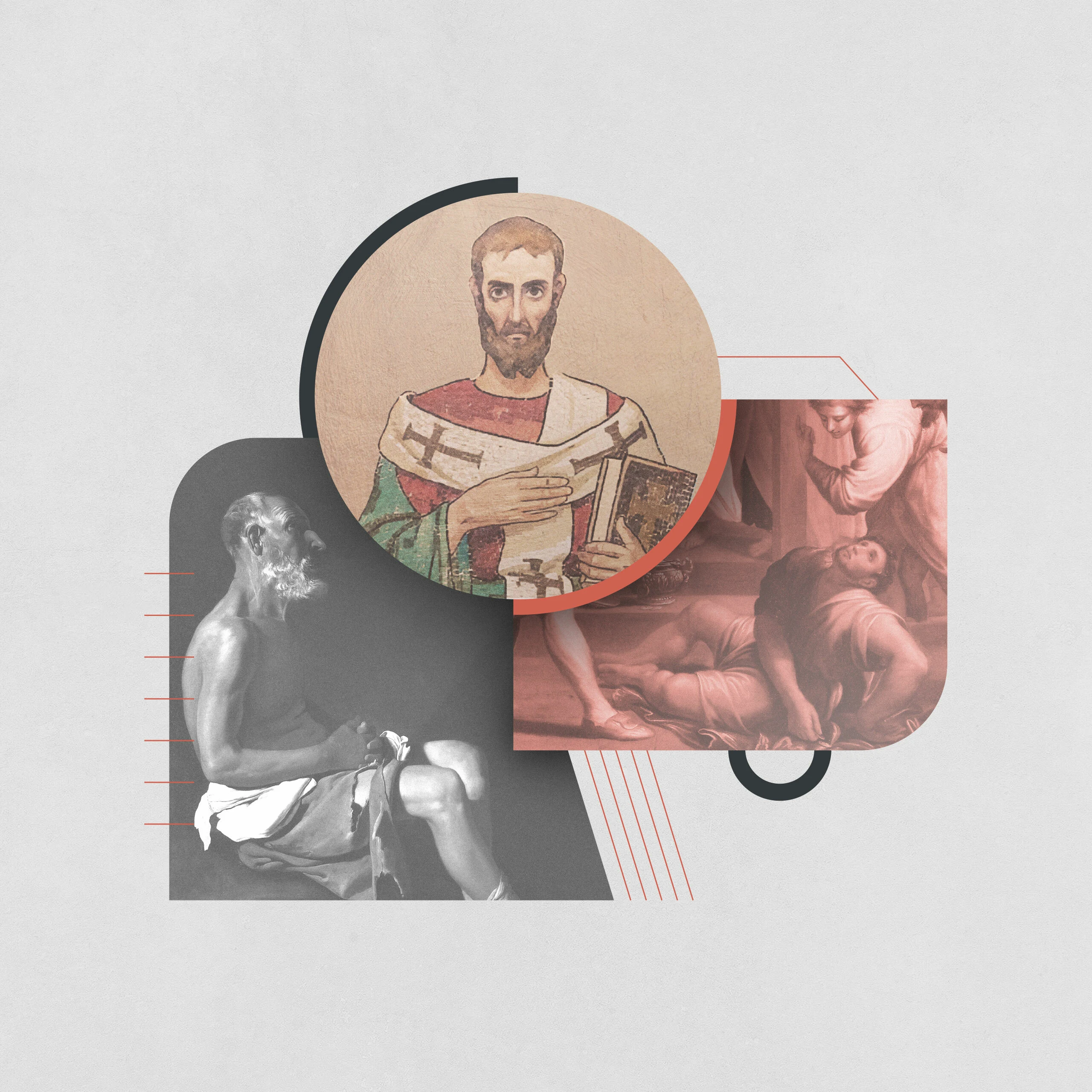
Who Was Peter?


While walking near the Sea of Galilee, Jesus encountered two fishermen—Simon Peter and his brother Andrew (Matt. 4:18). We know little about the two brothers prior to Jesus’ call to follow Him. Simon was married (Matt. 8:14–15; 1 Cor. 9:5) and worked on the sea. Previously, Andrew had been a follower of John the Baptist (John 1:35–41) but had come to believe that Jesus was the long-anticipated Messiah of Israel. Both men were among the first followers of Jesus. In John 1:42, John recounts that Jesus gave to Simon the name for which he is best known to us—Peter, which means “rock.” Along with John and James, Peter was counted among the inner circle of Jesus’ disciples.
According to the gospel accounts, Peter participates in a number of significant events associated with Jesus’ messianic mission. When Jesus ensured a miraculous catch of fish for the Galilean fishermen, Peter, along with James and John, “left everything” to follow Jesus (Luke 5:1–11). Peter was present for the healing of the daughter of Jairus—Jairus was the ruler of a synagogue in Capernaum (Mark 5:37–43). In what is the turning point in Jesus’ messianic ministry, Jesus asked the critical question of His disciples, “Who do people say that I am?” Peter was the first of the Twelve to make the confession that Jesus was the Messiah: “You are the Christ, the Son of the living God” (Matt. 16:16). Upon his confession, Jesus gave to Peter the keys of the kingdom of heaven, which came with the spiritual authority to bind and loose in heaven and upon the earth (Matt. 16:19).
But Peter was also prone to speak impulsively. During our Lord’s transfiguration (Matt. 17:1–8), Peter did not fully understand the significance of what was happening. Seeing the dramatic change in the appearance of our Lord, we read that “Peter said to Jesus, ‘Lord, it is good that we are here. If you wish, I will make three tents here, one for you and one for Moses and one for Elijah.’” When a voice from heaven announced, “This is my beloved Son, with whom I am well pleased; listen to him,” Peter and the others, James and John, were terrified and needed to be reassured by Jesus.
Peter was the first of the Twelve to make the confession that Jesus was the Messiah.
After Jesus predicted His coming death and resurrection (Matt. 16:21; 17:22–23; 20:17–19; Matt. 26:1–2), it was Peter who sought to change our Lord’s mind, only to be sternly rebuked by Jesus. Jesus turned to Peter and said: “Get behind me, Satan! You are a hindrance to me. For you are not setting your mind on the things of God, but on the things of man” (Matt. 16:23). After our Lord’s final Passover, when Jesus was betrayed by Judas, who directed a mob to Jesus seeking His arrest, it was Peter who drew his sword in Jesus’ defense, removing the ear of a man named Malchus (John 18:10). And it was Peter who was adamant that he would never deny Jesus, only to lose his nerve and do so three times after Jesus predicted that this would happen (Mark 14:29–31). Therefore, it was an act of grace and kindness that Jesus made one of His first post-resurrection appearances to Peter, assuring him of forgiveness and restoration (Luke 24:33–34; John 21:15–25).
At Pentecost, we learn that Peter was filled with the Spirit and transformed into a bold preacher of the gospel—starting with his famous Pentecost sermon, as recounted in Acts 2:14–21. Some three thousand people were converted that day (Acts 2:41). Peter continued preaching in Jerusalem, with many people healed and demons cast out as a manifestation of the advancing kingdom of God (Acts 3–4).
As the gospel spread throughout Judea, we later read of Peter’s role in the newly established church, where he stressed that gentiles were being saved in the same manner as believing Jews (Acts 15:7–11)—although he again wilted under pressure, this time from the Judaizers. Peter found himself confronted to his face and publicly by Paul in Antioch (Gal. 2:11–16). Peter was restored and continued his ministry.
Peter was the author of two New Testament epistles (1 and 2 Peter), both of which address the themes of suffering and persecution. Christian tradition holds that his subsequent ministry was later centered in Rome, where he was likely put to death in AD 64 during the Neronian persecution. The same tradition also holds that Peter insisted upon being crucified upside down, since he did not consider himself worthy to die in the same manner as his Lord.