How Did We Get the Westminster Shorter Catechism?

The Westminster Shorter Catechism is one of the most beloved and enduring summaries of the Christian faith in the Reformed tradition. Its clarity, brevity, and theological precision have made it a foundational teaching tool for generations of believers. But how did this remarkable document come into existence? To understand the Shorter Catechism, we must step back into a time of political upheaval, ecclesiastical reform, and deep concern for doctrinal faithfulness in the mid-seventeenth century.
A Time of Crisis and Opportunity
The 1640s in England witnessed tremendous upheaval, as tensions between King Charles I and Parliament erupted into the English Civil War (1642–1651). At the heart of the conflict were not only political questions about authority and governance, but also deeply rooted disagreements about the nature of the church.
The Church of England—shaped by earlier reforms under Henry VIII, Edward VI, and Elizabeth I—retained many elements that some believed were insufficiently Reformed. The Elizabethan Settlement (1559), in particular, sought to combine a Protestant theology with a Roman Catholic aesthetic—a “middle way” (or via media) between the two. In other words, while Protestant, the Church of England retained the government as well as the experiential elements (the “smells and bells”) of Rome.
The English Puritans sought to purify the Church of England from its Roman Catholic vestiges. Influenced by the Reformed theology from Geneva and Wittenberg (among other places), they longed for the church and her worship to be more thoroughly grounded in and regulated by Scripture.
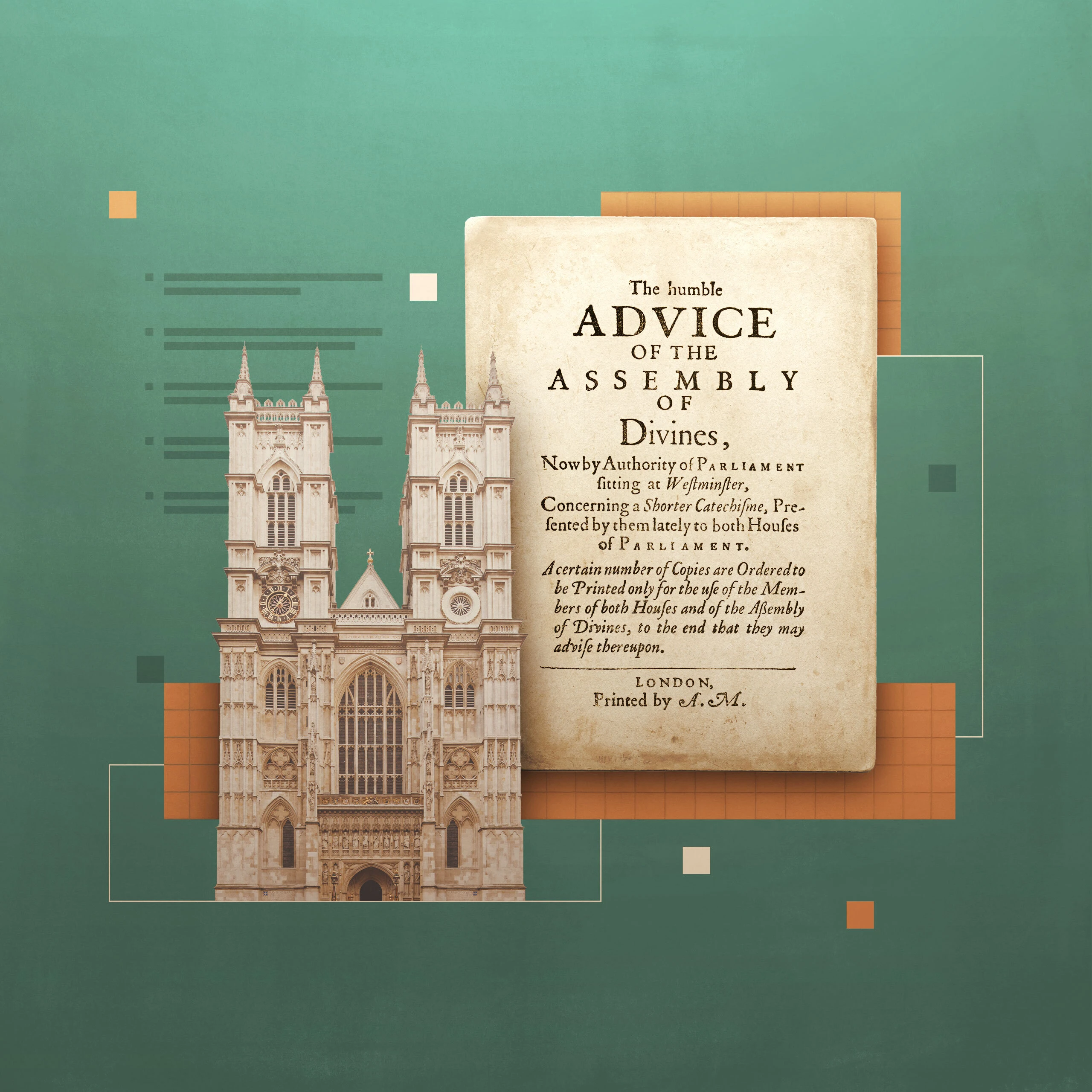
In 1643, the English Parliament called together an assembly of theologians and church leaders to advise on matters specifically of doctrine and worship. This gathering, known as the Westminster Assembly, met at Westminster Abbey in London. The assembly would not merely revise existing documents (such as the Thirty-Nine Articles) but also produce an entirely new body of doctrinal standards. Among these were the Westminster Confession of Faith, the Larger Catechism, and the Shorter Catechism.
Why a “Shorter” Catechism?
Catechisms—structured question-and-answer summaries of doctrine—had long been used in the church as tools for instruction. The Reformers, including Luther and Calvin, produced catechisms to teach biblical truth systematically, especially to children and new Christians. The Westminster Assembly followed this tradition by first producing the Westminster Larger Catechism, a comprehensive and detailed exposition of Christian doctrine. However, the assembly recognized the need for a more concise version that would be accessible to children and those new to the faith.
The Shorter Catechism stands as a reminder that clear, concise, and biblical instruction is not only possible, but essential.
Thus, the Westminster Shorter Catechism was written not as a lesser document, but as a more accessible one. It distills the same rich theology of the confession and Larger Catechism into 107 carefully crafted questions and answers.
Crafting the Catechism
The Shorter Catechism was completed in 1647 (approved in 1648) and presented to both the English and Scottish churches. It reflects the collaborative work of the assembly, though certain individuals played particularly significant roles in shaping its content. The Westminster divines were deeply committed to grounding every statement in Scripture. They carefully crafted every word to be both precise and memorable. The result is a document that is both theologically robust and pedagogically effective.
The Shorter Catechism is structured in a logical and pastoral way. It begins with man’s chief end—“Man’s chief end is to glorify God, and to enjoy him forever”—and proceeds to unfold what we are to believe concerning God and what duty God requires of man. It covers doctrines such as the doctrine of Scripture, the nature of God, the decrees of God, creation, providence, the fall, redemption in Christ, and the elements of salvation. It then turns to the moral law, expounding the Ten Commandments, before addressing the means of grace: the Word, sacraments, and prayer.
Adoption and Influence
The Westminster Shorter Catechism was formally adopted by the Church of Scotland in 1648 and became a central teaching tool in Scottish Presbyterianism. Although the political situation in England shifted dramatically with the restoration of the monarchy in 1660, limiting the catechism’s official use in England, it continued to flourish in Scotland and later in Presbyterian churches around the world.
In America, the Shorter Catechism became a standard for Presbyterian churches and was (and remains) widely used in both the church and home. For centuries, children were expected to memorize its questions and answers, embedding deep theological truths in their hearts and minds. Its influence extends far beyond Presbyterian circles. Many Reformed and evangelical churches from various denominations have drawn from its language and structure in their teaching ministries.
Enduring Value
What explains the enduring power of the Westminster Shorter Catechism?
- Its God-centeredness
It begins with God’s revelation and keeps Him at the center throughout. This reflects the Reformed conviction that theology is ultimately about God and His purposes.
- Its biblical fidelity
The catechism is saturated with Scripture. Though the Scripture proofs were added later, they demonstrate that every doctrine is rooted in the Word of God.
- Its clarity, brevity, and memorability
The concise, carefully worded answers make it ideal for instruction and retention. Phrases such as “justification is an act of God’s free grace” or “sanctification is the work of God’s free grace” have shaped the theological vocabulary of countless believers.
- Its pastoral usefulness
The catechism is not merely an academic exercise; it is a tool for discipleship. It teaches believers how to think rightly about God, themselves, and the Christian life.
Conclusion
The Westminster Shorter Catechism emerged from a unique moment in history—a time of crisis, reform, and an earnest desire for doctrinal clarity. Yet its value has far outlasted the circumstances of its origin. Born out of the labors of faithful pastors and theologians, shaped by Scripture, and refined for the instruction of God’s people, it remains one of the most effective summaries of the Christian faith ever produced. In an age often marked by theological confusion and shallow teaching, the Shorter Catechism stands as a reminder that clear, concise, and biblical instruction is not only possible, but essential.