How Did We Get the Canons of Dort?

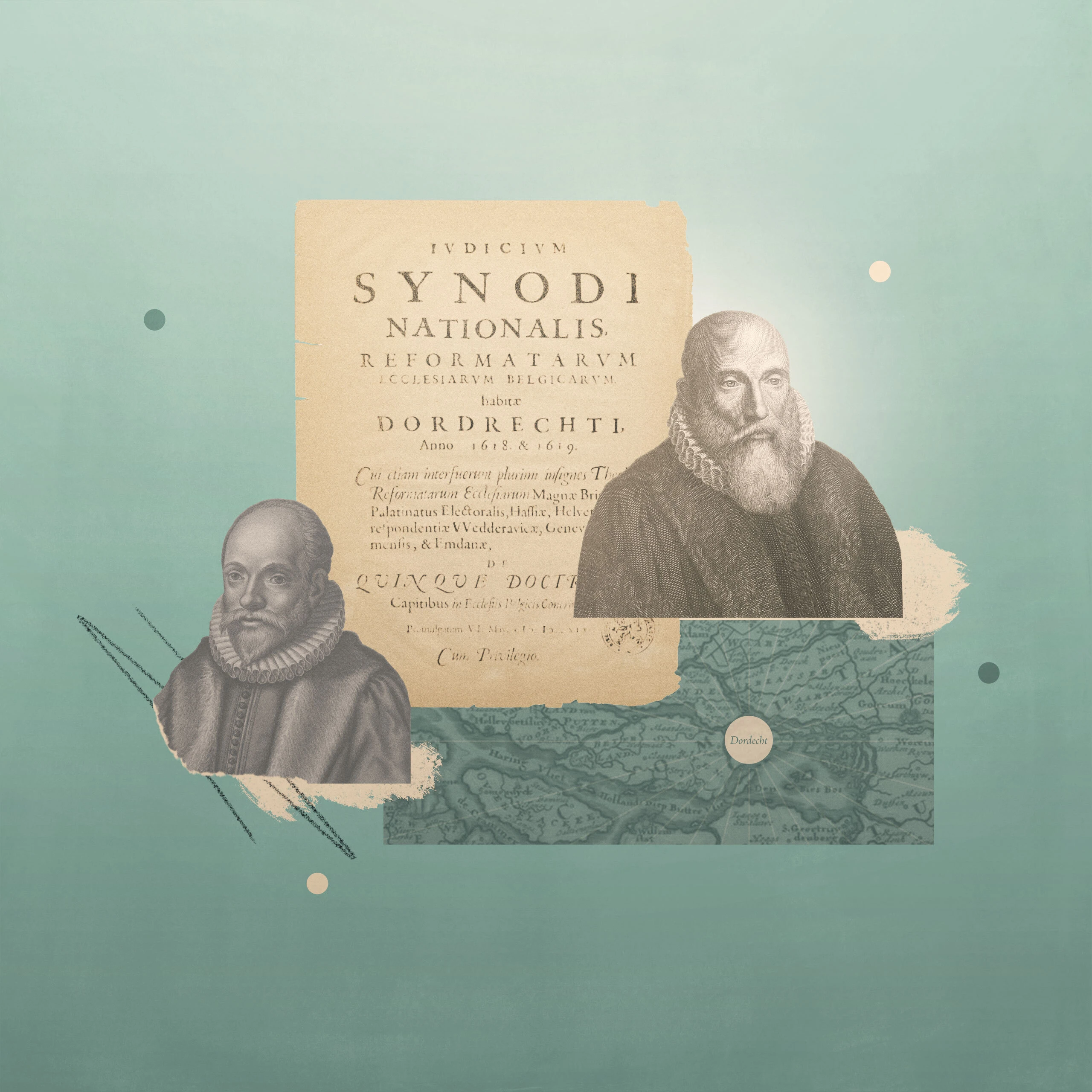
On May 6, 1619, delegated pastors and professors from across Europe processed through the streets of Dordrecht to the Grote Kerk, the “Great Church.” There the Canons of Dort were read publicly in Dutch for the town and its guests to hear. As each delegate’s name was called, he tipped his hat in assent. Ever since, the Canons have belonged to the confessional heritage of the Dutch Reformed churches.
But how did everyone get there in the first place?
To answer that, we need to go back to the sixteenth and early seventeenth centuries, when the Netherlands became the scene of a fierce struggle politically and theologically over the grace of God.
The Reformation did not necessarily start on October 31, 1517, with Martin Luther, nor did it arrive in the Netherlands on untilled soil. For generations, reforming movements had been calling the church back to the Word in a series of medieval debates. Groups such as the Waldensians and Lollards had fled there, and movements within the Netherlands, such as the Brethren of the Common Life, encouraged a simple, Scripture-shaped piety. It’s said that on the eve of what we call “the Reformation,” Frisian fishermen living in huts could read, write, and discuss Scripture.
Upon this latest reformation movement in the Netherlands came the weight of empire. The seventeen provinces of the Netherlands were ruled by Charles V, Holy Roman Emperor. Under his son and successor, Philip II of Spain, persecution intensified. While Charles enacted laws outlawing Protestantism, he never strictly applied them. Philip, however, did. He forbade reading and possessing forbidden books, worshipping outside the Roman Church, talking openly or secretly about the Scriptures, and teaching the Scriptures unless one was a graduate of a university. The penalties were severe: the sword for males, being buried alive for females, and fire for those who wouldn’t confess. If you failed to inform the authorities of someone later found to be a heretic, you’d be guilty. Tensions boiled over in 1566 in the beeldenstorm, the wave of public iconoclasm. In the years that followed, resistance to Spanish rule grew under William of Orange, the Netherlands’ leading noble, and the northern provinces eventually united in open revolt. In 1583, the new United Provinces rejected Philip’s rule.
That political upheaval formed the backdrop for the theological controversy that would later produce the Canons of Dort.
At the eye of that storm stood Jakob Harmenszoon, Latinized as Jacobus Arminius. Educated at Leiden and then abroad, Arminius had strong Reformed credentials and even a glowing letter of recommendation from his professor at Geneva, Theodore Beza. In 1588, he became a pastor in Amsterdam. Yet as he preached through Romans, concerns began to grow. While in Romans 2, he said his hearers would have been better off if they had remained in the Roman Church because at least, they would be doing good works in the hope of eternal reward, while now they did none at all. In Romans 5, he said death was inevitable even if Adam had obeyed the Lord’s command. In Romans 7, he moved away from the Augustinian tradition, suggesting that Paul was speaking of the unregenerate man. Especially in Romans 9, he interpreted “Jacob I loved and Esau I hated,” as classes of people rather than individuals.
Arminius’ senior colleague, Petrus Plancius (1552–1622) protested to the consistory (the ruling church council), which investigated Arminius, but nothing came of it. These concerns only intensified after Arminius became professor at Leiden in 1603. His colleague, Franciscus Gomarus, came to believe that Arminius’ theology endangered the church’s doctrine of justification by faith alone. If election was grounded in foreseen faith, then faith itself seemed to become a kind of work. The issue was no mere academic quarrel. It touched the very question of whether salvation is wholly of grace.
At every point, they defended the same great truth: Salvation from beginning to end is of the Lord.
Many ministers called for a national synod to settle the matter. But in the Dutch Republic, theology and politics were tightly bound together. Some sided with the church’s right to govern its own doctrine and discipline; others insisted that the civil authorities had the decisive voice. Conferences were held in 1607 and 1609 between Arminius and Gomarus, but nothing was resolved. Arminius died in 1609, remembered even by opponents as a humble and godly man, but the controversy did not die with him.
His death didn’t end the fight. In January 1610, forty-three ministers sympathetic to Arminius met in Gouda and issued a five-point document called The Remonstrance, meaning “public protest.” From that point on, they were known as the Remonstrants. Their opponents replied in 1611 with a Counter-Remonstrance. The conflict spread from lecture halls and consistories into the pews and the streets. Congregations divided. Worshipers moved from church to church to avoid certain preachers. Riots broke out. By 1617 and 1618, the Dutch Republic itself was nearing civil conflict, just as the threat of renewed war with Spain loomed.
Under that pressure, the States General finally called a national synod. At the urging of King James I of England, it became an international synod. Reformed churches from across Europe were invited to send delegates so that the Dutch churches would not settle this matter in isolation. This was no small provincial meeting. It was, as one observer put it, a muster of the forces of Calvinism.
The Synod of Dort met from November 1618–May 1619. Dutch delegates were joined by representatives from England, the Palatinate, Hesse, the Swiss Republics, Bremen, and Nassau-Wetteravia. Due to political pressures and distance, the French and Brandenburgers were not able to attend.
The Remonstrants were summoned to appear and defend their views. But the proceedings quickly bogged down as their leading spokesman, Simon Episcopius, challenged the synod’s right to judge them and sought to redirect the debate. After weeks of delay and frustration, President Johannes Bogerman finally dismissed them with the famous order: “You are dismissed! Get out!”
After that, the synod examined the Remonstrant teachings from their published writings and set to work. A drafting committee, made up of Dutch and foreign delegates, labored intensely to produce what became the Canons of Dort.
The Canons were not written as a detached theological treatise. They were a pastoral and polemical response to a real crisis in the church. They addressed five disputed heads of doctrine, each one tied to the Remonstrant challenge. At every point, they defended the same great truth: Salvation from beginning to end is of the Lord. God’s election is gracious, Christ’s atonement is powerful, the Spirit’s calling is effectual, and God preserves His people to the end.
That is how we got the Canons of Dort: through persecution, political upheaval, ecclesiastical controversy, and a major international synod. The Canons were born in a fight over grace. That is why they still matter. They are the church’s confession that sinners are saved not by the uncertainty of their own will, but by the free, sovereign, and steadfast mercy of God.