How Did We Get the Baptist Catechism?

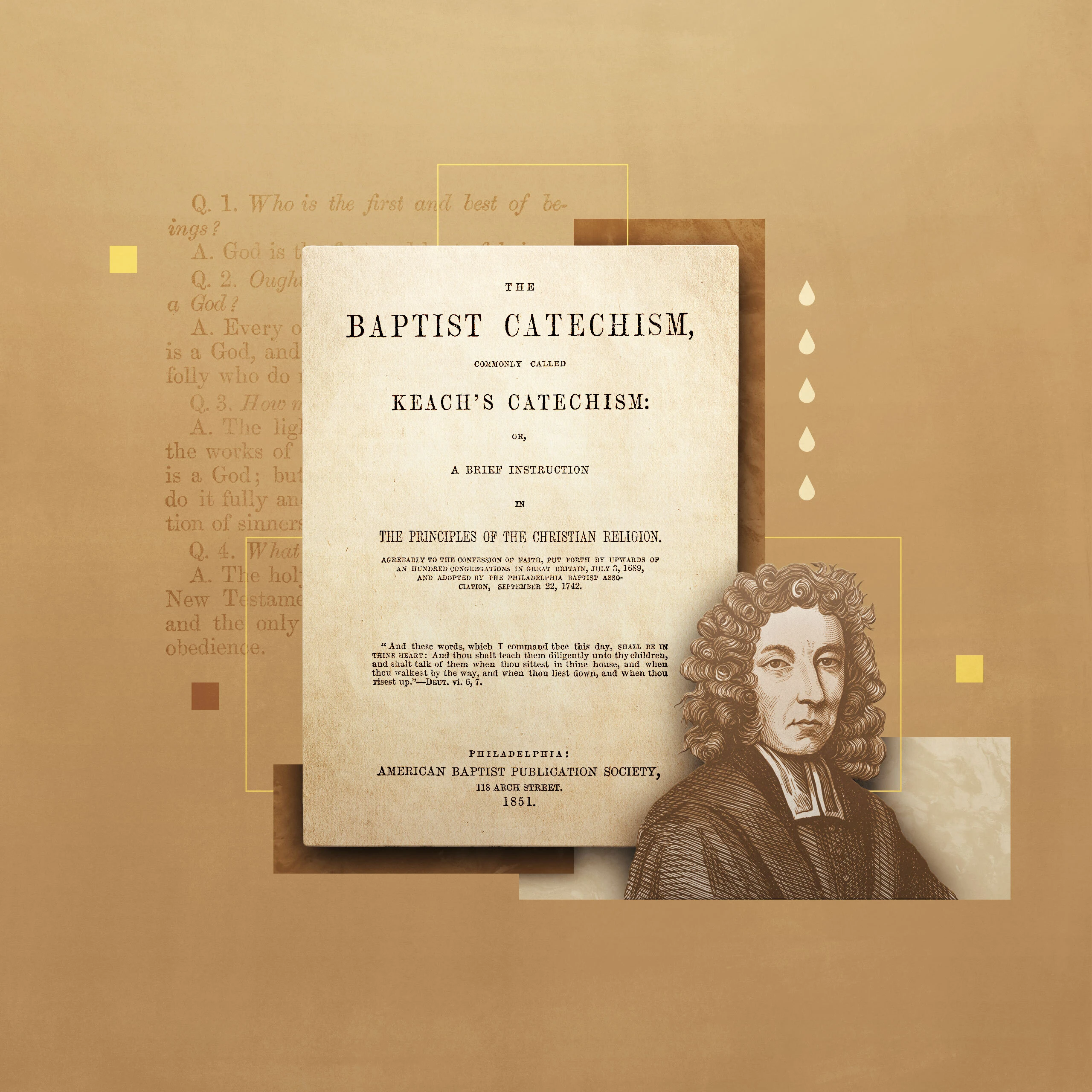
For many Baptists, the word catechism sounds Roman Catholic, Lutheran, or Presbyterian. They are shocked to discover that the word katēcheō appears in various forms at least seven times in the New Testament (see Luke 1:4; 1 Cor. 14:19). It simply means “to teach orally.” And Baptists have almost from their beginning written catechisms to assist their churches in systematically teaching God’s Word. Among all the catechisms Baptists have produced, one stands alone as foremost. Its formal title is The Baptist Catechism, Commonly Called Keach’s Catechism: Or, a Brief Instruction in the Principles of the Christian Religion.
This catechism arose out of the stream of orthodox, evangelical, Protestant, and Reformed teaching that traces its origins to the earliest centuries of the New Testament church. In those early centuries, the specific form of oral instruction that uses carefully worded, vital religious questions with succinct, biblical answers became standard practice among Christians. By the middle of the second century, this method was used to prepare new converts for baptism. The period for such catechetical instruction could last for a year or more. During that time, the catechumen would reflect on whether he wanted fully to submit to baptism, and the church could observe the sincerity of his profession of faith in Christ.
By the end of the fourth century, the practice of catechizing shifted to focus on those already baptized in preparation for their confirmation in the faith. During the centuries of the Middle Ages, the work of catechizing became less popular. In some places, it disappeared completely.
With the rise and spread of the Reformation in the sixteenth century came a renewed emphasis on catechetical teaching. Tom Nettles calls this era “the Golden Age of catechisms.” Martin Luther wrote both his Large Catechism and his Small Catechism in 1529 to help overcome the lack of basic biblical knowledge among those who called themselves Christians in Saxony. John Calvin was similarly motivated when, after three earlier attempts to provide simple doctrinal instruction for children, he produced the Catechism of the Church of Geneva in French (1542) and then translated it into Latin (1545).
When modern Particular Baptists arose in the seventeenth century, both Roman Catholics and their fellow Protestants confused them with various strains of Anabaptists because of their conviction that only those who have conscious faith in Christ are qualified to receive baptism as the sign of the new covenant. This led the Baptists to produce two confessions of faith, the first in 1644 (the First London Baptist Confession) and the second in 1677 (formally published in 1689 as the Second London Baptist Confession).
With the rise and spread of the Reformation in the sixteenth century came a renewed emphasis on catechetical teaching.
The latter became the most widely acclaimed confession among Baptists in the eighteenth century and into the nineteenth. This was particularly true of Baptists in the southern part of America. In the preface to the Second London Baptist Confession, its framers declare to “have no itch to clog religion with new words.” Rather, they readily admit their reliance on and great agreement with the Westminster Confession (1646) and Savoy Declaration (1658). By publishing their own confession, the Baptists desired to show their unity with other Protestants on essential doctrines while articulating their distinctive differences on the sacraments and the church.
In keeping with that same spirit and a desire to provide distinctively Baptist instruction for Baptist homes, the General Assembly of Particular Baptists in England passed a resolution in 1693 calling for the creation of a catechism by one of their own. The resolution resolves “that a catechism be drawn up, containing the substance of the Christian religion, for the instruction of children and servants; and that Brother William Collins be desired to draw it up.”
Collins was pastor of the Petty France Church of London. There is some evidence that the catechism was first published by the end of 1694, though the earliest extant copy is from 1695 and is identified as the fifth edition. The document exudes not only the same doctrine but also the same spirit of the Second London Baptist Confession. Just as the confession draws heavily from the Westminster and Savoy, so the Baptist Catechism relies heavily on the Shorter Catechism published by the Westminster Assembly in 1647.
The preface to the fifth edition of the Baptist Catechism explains the purpose and rationale for its production, describing it as “a short account of Christian principles, for the instruction of our families, in most things agreeing with the Shorter Catechism of the Assembly. And this we were the rather induced to, because we have commonly made use of that Catechism in our families, and the difference being not much, it will be more easily committed to memory.”
Why has it been regularly called Keach’s Catechism, after Benjamin Keach (pastor of Horseleydown Church in London), rather than Collins’ Catechism since Collins was commissioned to produce it? This remains a mystery hidden in the lacuna of historical records. It is widely assumed that Keach and Collins collaborated the catechism into existence.
One hundred of the Westminster Shorter Catechism’s 107 questions and answers are copied identically in the Baptist Catechism. The Baptist version has 114 total questions and answers with only the first question and the ones about the Lord’s Supper and baptism differing from its parent document.
Though details of its origins may never be discovered, its great value to Baptists over nearly three and one half millennia cannot be disputed.