How Did We Get the Westminster Confession of Faith?

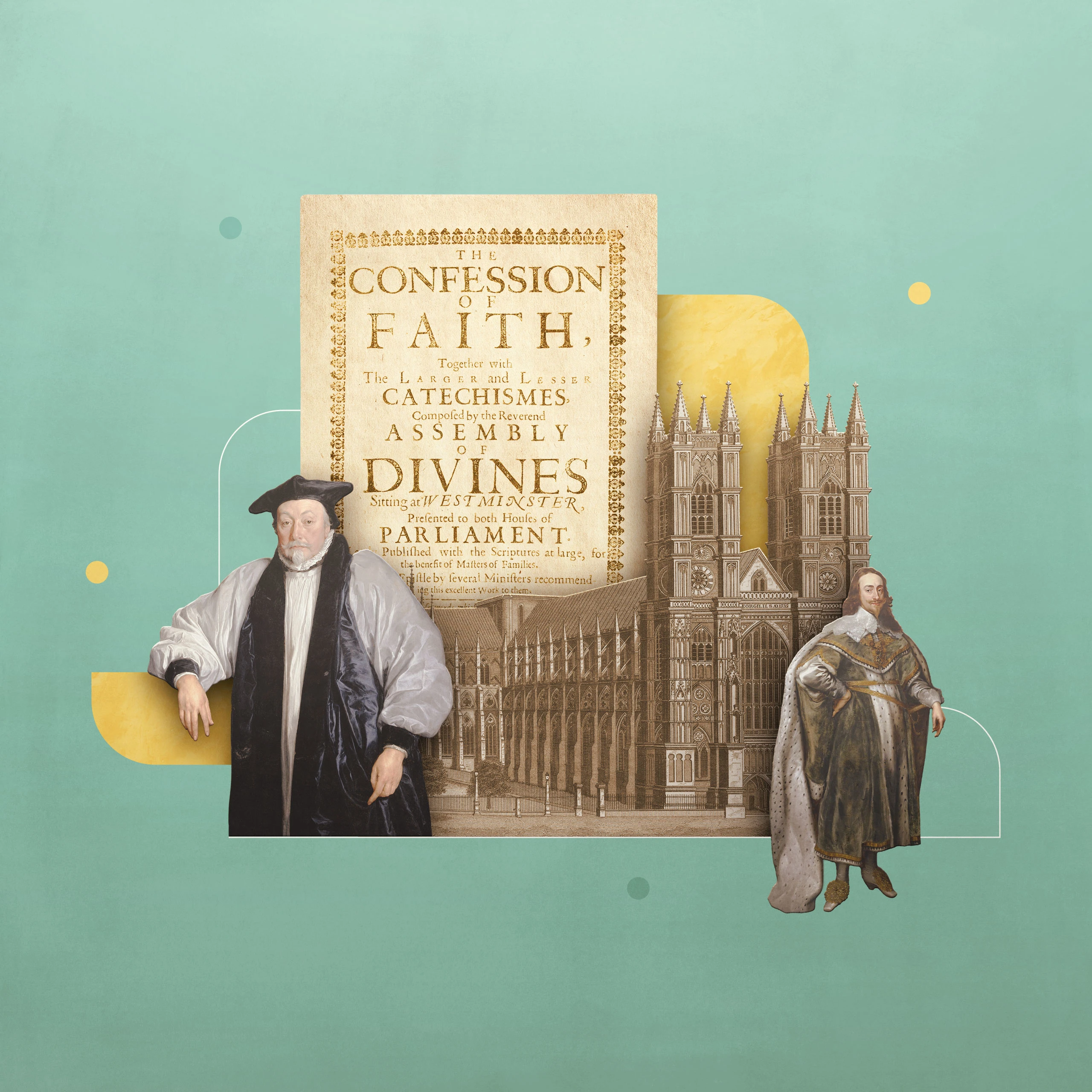
Have you ever started a project with a specific goal in mind, only to realize along the way that the final product would look very different from what you’d originally planned? If so, then you can understand something of how the Westminster Confession of Faith came to be.
How It Came to Be
The creation of the Westminster Confession represents the crescendo of a century of political and religious upheaval on the British Isles. Beginning in 1534 with the Act of Supremacy, whereby Henry VIII declared himself to be the head of the Church of England, English Christianity underwent considerable change. Thanks to the reforms of Henry’s Protestant son, Edward VI (reigning 1547–1553), and Protestant daughter, Elizabeth I (reigning 1558–1603), the Church of England adopted the Book of Common Prayer for its worship and the Thirty-Nine Articles of Religion as its confession of faith, which was Reformed in character. Though these represented a positive shift away from the theology of Rome, there were still those within the Church of England who desired further reform, namely the Puritans. Their primary objections were to the fixed liturgy of the Book of Common Prayer, clerical vestments, and rule by bishops (episcopacy).
Charles I (reigning 1625–1649), together with the Archbishop of Canterbury, William Laud, ratcheted up tensions even further. Charles, a firm believer in the divine right of kings, ruled without the consent of Parliament for eleven years (also known as Personal Rule). Laud disregarded Puritan concerns and espoused Arminian theology, prioritized the Lord’s Supper over preaching, and insisted on the divine right of bishops. After trying to impose the Book of Common Prayer upon the Scottish Church in 1637, the Scottish Covenanters rebelled against the Crown in the First Bishops’ War (1639). Charles had no choice but to call Parliament with the hope that it would raise taxes to fund the war effort. Charles’ hopes were frustrated when Parliament sought instead to limit his powers as king. The ensuing conflict between Charles and Parliament eventually led to the English Civil War (1642–1651). On the one side were the Royalists who supported Charles I and the religious status quo, and on the other the English Parliament and Scottish Covenanters who desired reformation of the Church of England along Presbyterian and Reformed lines.
In surveying the historical context of the Westminster Confession, we are given fresh reasons to praise the sovereignty and wisdom of our God.
To that end, Parliament moved to abolish rule by bishops in 1642 and appointed 151 men to assemble in Westminster Abbey on July 1, 1643, to reform the church’s government and liturgy according to the Word of God and to defend the reformational theology of the church. The divines’ original assignment was to clarify and defend the Thirty-Nine Articles of Religion. But after signing the Solemn League and Covenant (1643) wherein England vowed to pursue religious uniformity together with Scotland (which was Presbyterian), plans changed. The Thirty-Nine Articles were set aside and the assembly began its work on a new confession of faith.
What It Continues to Be
In surveying the historical context of the Westminster Confession, we are given fresh reasons to praise the sovereignty and wisdom of our God. What arose out of a period of political and religious division, God has used as one of the most unifying theological confessions in the world. Today there are men and women, boys and girls, on every continent who point to the work of the Westminster divines as the confession of their faith.
The confession is further unifying in its unwavering commitment to the doctrine of sola Scriptura. As the assembly neared completion of the confession in 1646, Parliament requested that the divines provide Scripture references to support their claims. The next year, the assembly presented no less than 2,500 proof-texts, demonstrating their commitment not to doctrines and commandments of men but to the authoritative Word of God.
Charles Spurgeon once said of John Bunyan: “Prick him anywhere; and you will find that his blood is Bibline, the very essence of the Bible flows from him. He cannot speak without quoting a text, for his soul is full of the Word of God.”1 If you read the Westminster Confession of Faith, I expect you will feel the same way. You’ll find it to be overwhelmingly bibline; its soul is full of the Word of God. And that is a confession worth believing, indeed.
-
Charles H. Spurgeon, The Autobiography of Charles H. Spurgeon: Compiled from His Diary, Letters, and Records by His Wife and Private Secretary, vol. 4, 1878–1892 (Curts & Jennings, 1900), 268. ↩