Who Was John?

When we are looking for a book to read—especially if it is by an author we have not read before—it is not unusual to look for the “blurb” that provides information about the author and their rationale for writing. So too when it comes to exploring the Gospels. However, partly because the human authors of the Gospels did not take the initiative of writing upon themselves, we often find them reluctant to say much about themselves. The words that they were enabled to pen as they were “carried along by the Holy Spirit” were designed to throw the spotlight not on them, but on their ultimate author, God (2 Peter 1:21).
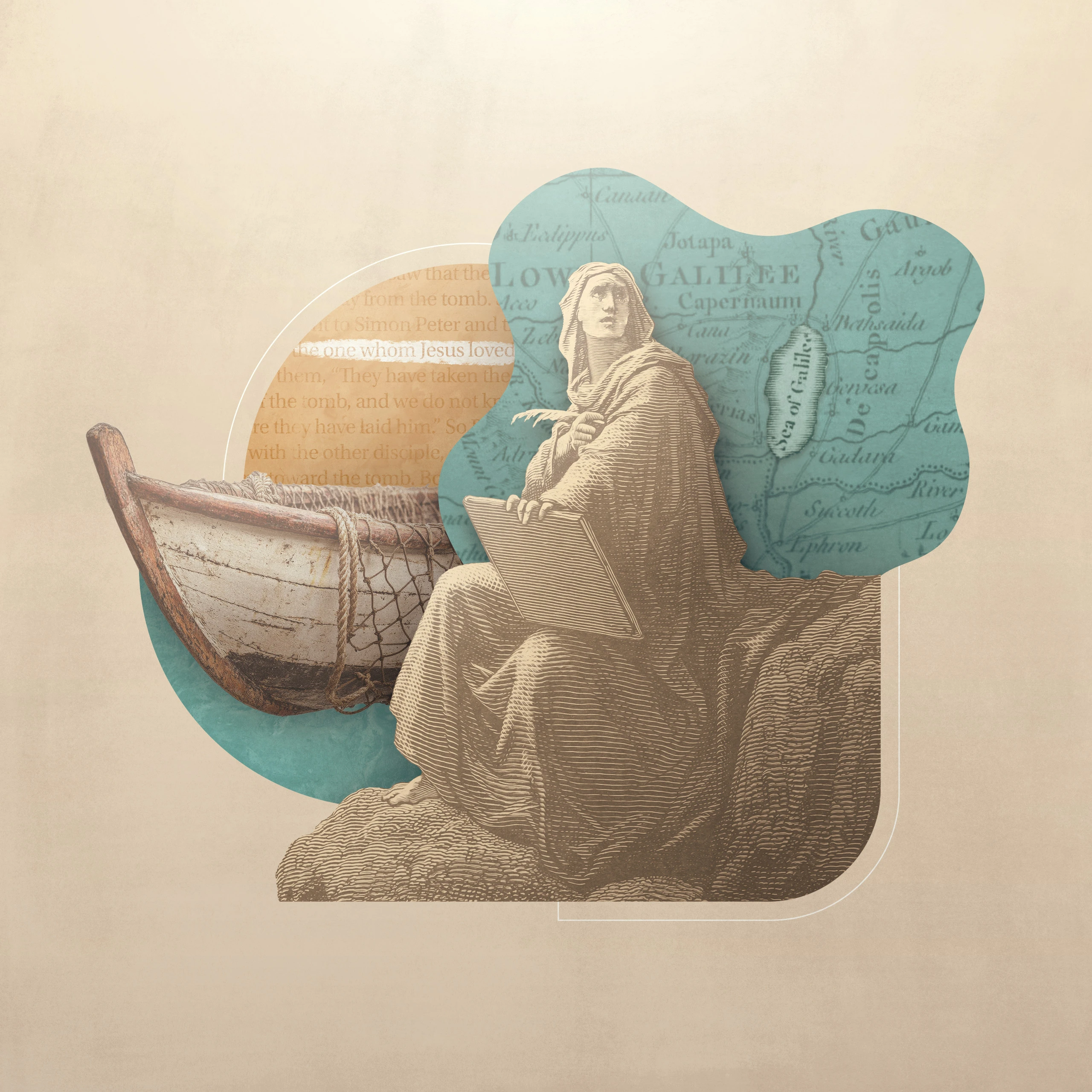
Who, then, was John, the fourth of the Gospel authors? We first meet him in the gospel record at the very beginning of Christ’s earthly ministry, in Mark’s account of Jesus’ calling the first disciples by the Sea of Galilee (Mark 1:16–20). The first to be mentioned were Simon and Andrew, who were brothers and fishermen by trade. But almost immediately after this, we are told that Jesus approached two other young men, James and John, who were sons of Zebedee and also fishermen on the Sea of Galilee. They all responded to Christ’s invitation by leaving their nets—which were their source of income—and following Jesus.
It would be easy to downplay the courage of the first disciples’ response or fail to appreciate the significance of what this step of faith meant for them in real terms. They were prepared to walk away from the safety of an assured income to entrust themselves to an unknown carpenter’s son from Nazareth. Was it blind faith on their part? No!
The four men whom Jesus called at this point clearly had an attachment to the local synagogue, the place where Jesus was asked to preach the following Sabbath when He was publicly challenged by the shouts of an evil spirit who had taken possession of one of the worshippers (Mark 1:21–27).
The newly called disciples, as much as the other congregants present that day, must have been profoundly shaken by what happened, partly due to the shock of the demonic outburst, but even more so by the calm yet irresistible authority of Jesus’ words.
We cannot help but be touched by his deep affection for the many believers he had taught and pastored throughout his ministry, as well as the outpouring of Christ-centered love he displays toward them.
As Mark’s account of the newly formed group of disciples unfolds, we see the dynamic of the Twelve evolving too. Most significantly, out of the larger entourage that attached themselves to Him, Jesus singled out twelve whom He appointed to be His Apostles. These He instructed and equipped for the larger task that would be entrusted to them—namely, to bear witness to the fact that He was indeed the Messiah for whom Israel was waiting and through whom salvation would be brought to the nations.
The first three Gospels have been dubbed the Synoptics—that is, they provide an overview of the life and work of Jesus from the same general perspective. But John takes a different perspective. Like a visitor to an art gallery who selects a few works for more detailed perusal, John chooses particular aspects of Christ and His work for close consideration. His is a reflective gospel, one that takes us by the hand and leads us into the depths of the mysteries of Christ’s person and the wonders of all He accomplished for His people and for the world.
It is interesting, therefore, that the gospel that bears John’s name never explicitly identifies him as its author. Rather, it refers repeatedly to him as “the disciple whom Jesus loved” (John 13:23; 19:26; 20:2; 21:7, 20). It does so in a way that indicates it was this disciple who wrote it. Indeed, as the end drew near for Jesus on the cross, John was the only disciple who dared to stand there along with Mary the mother of Jesus, Mary the wife of Clopas, and Mary Magdalene. And it was to John that Jesus lovingly entrusted His grieving mother that he might care for her (John 19:26–27).
We catch other glimpses of John and his relationship with Jesus elsewhere in the New Testament record. In the three brief epistles that bear his name, we cannot help but be touched by his deep affection for the many believers he had taught and pastored throughout his ministry, as well as the outpouring of Christ-centered love he displays toward them.
There is, however, one other major New Testament book that John was enabled to write through the Holy Spirit, one that would become a significant part of the divine self-disclosure—namely, Revelation, or the Apocalypse of John. Even though he was in exile on the island of Patmos at that time, his faith was not shaken, and God was not done with him. It was there that God gave him a glimpse of the future that would guide and keep the faithful from the end of the New Testament age right through to the parousia—the day of our Lord’s return in glory. The climax of this revelation in its closing chapters gives us the most breathtaking glimpse of the new heavens and the new earth that will be ushered in on the day of Christ’s return. What a comfort this must have been to the aging Apostle in his dire circumstances, and what a glorious hope it is for every believer. And, so too, what an encouragement to get to know this gospel author more deeply.